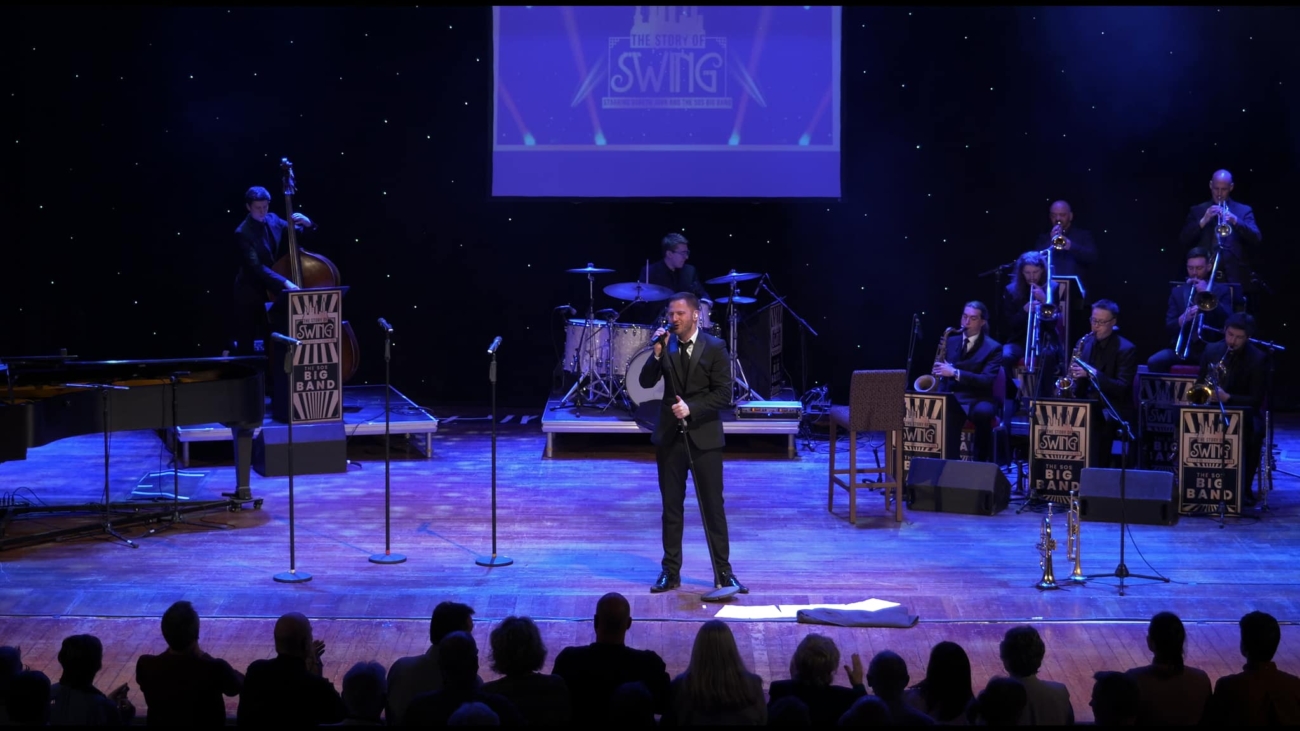
There is a distinct shift happening across the global music landscape—and it is unmistakably live, unfiltered, and rooted in the raw electricity of performance. From the world’s most prestigious concert halls to underground jazz collectives and international festival circuits, live jazz, live big band, and live swing are not only surviving—they are expanding, evolving, and commanding global attention in 2026.
For listeners of The Improv Cafe’, this is more than a trend. It is a validation of the format: a station dedicated exclusively to live recordings, real-time improvisation, and the authentic sound of musicians interacting in the moment. What is unfolding worldwide reinforces a singular truth—the future of jazz is being built in real time, on stage, in the room, and captured live.
The Global Stage Is Reclaiming Live Jazz
Across continents, live jazz performance has become the primary driver of the genre’s growth. Traditional touring models are giving way to curated festival circuits, extended residencies, and venue-based programming designed specifically for large ensembles.
In the United States, New York City continues to function as the operational nucleus of big band performance. At Jazz at Lincoln Center, the calendar remains dense with full-scale orchestras, vocalist-led big band arrangements, and recurring live performance series that prioritize ensemble interplay over studio perfection. Events like the Essentially Ellington Festival are not simply showcases—they are talent pipelines feeding the next generation of arrangers, bandleaders, and improvisers into the global ecosystem.
Just across the Hudson, the New Jersey corridor has quietly become one of the most consistent incubators of serious ensemble work. Series like Jazz in the Loft in South Orange and university-driven programs such as the Princeton Creative Large Ensemble are producing performances that blur the line between academic rigor and professional-level execution. These are not isolated shows—they are part of a broader infrastructure supporting live composition, rehearsal-based development, and performance-first artistry.
Europe: The New Power Center of Big Band Innovation
While the United States maintains its historical foundation, Europe has emerged as a dominant force in modern big band evolution. The shift is structural. Government-supported arts funding, radio orchestras, and conservatory pipelines have created an environment where large ensemble jazz can thrive consistently.
Festivals such as Jazz Baltica represent the scale of this movement. With dozens of performances spanning multiple days, these events are not merely concerts—they are global convenings of composers, arrangers, and large ensemble innovators. Central to this ecosystem is the NDR Bigband, a flagship ensemble that continues to redefine orchestration through contemporary textures, cross-genre integration, and forward-thinking programming.
Across Germany, Scandinavia, and the Netherlands, the modern big band is no longer defined by swing-era nostalgia. Instead, it incorporates:
- Cinematic scoring techniques
- Electronic layering and ambient textures
- Classical compositional frameworks
- Improvisational structures that extend beyond traditional forms
This is where big band is being reimagined—not as a preservation project, but as a living, evolving format.
The Rise of Global Jazz Ecosystems
Beyond Europe and the United States, jazz has fully established itself as a global network rather than a regionally concentrated genre.
Massive international events like the Java Jazz Festival demonstrate the scale of audience demand, drawing tens of thousands of attendees and presenting artists from across continents. Meanwhile, industry-facing platforms such as Jazzahead! function as the business engine of the genre, connecting artists, labels, promoters, and festivals into a continuous touring pipeline.
In Australia, the Melbourne International Jazz Festival continues to expand its programming, emphasizing large ensembles and cross-disciplinary collaborations that merge jazz with visual art, film scoring, and contemporary composition.
These global nodes are interconnected. Artists move between them fluidly, building international careers that rely less on traditional touring routes and more on strategic festival appearances and collaborative projects.
Big Band Goes Mainstream Again—But Not As You Remember It
One of the most significant developments in 2026 is the re-entry of big band instrumentation into mainstream cultural visibility—but in transformed form.
Groups like Snarky Puppy are leading this shift. With orchestral-scale projects and collaborations with ensembles such as the Metropole Orkest, they are effectively operating as modern big bands, blending jazz improvisation with funk, world music, and cinematic arrangement.
Simultaneously, acts like The Roots are bringing large ensemble performance into major festival environments, while Jeff Goldblum & The Mildred Snitzer Orchestra continues to attract global audiences with a traditional jazz presentation wrapped in contemporary appeal.
The implication is clear:
Big band is no longer confined to jazz audiences—it is being reintroduced to broader markets through hybrid formats.
The Live Album Renaissance
Parallel to the surge in live performance is a global resurgence in live jazz recordings. Labels, artists, and institutions are increasingly prioritizing releases captured in real environments—concert halls, radio sessions, and festival stages.
Recent projects such as:
- In My Dreams
- Live at KNKX
- Future Past Present
reflect a broader industry pivot toward documenting the immediacy of performance rather than constructing perfection in studio isolation.
This aligns directly with the programming philosophy of The Improv Cafe’:
what matters most is not the take—it is the moment.
A Parallel Revival: Vintage Swing and Early Jazz
While innovation drives one side of the spectrum, another movement is unfolding simultaneously—a return to early jazz traditions.
In Spain, ensembles like the 12-piece group Hot Chocolates are reinterpreting 1920s-era jazz with period accuracy and modern energy. Across the UK and international showcase circuits, artists are revisiting swing-era frameworks, not as nostalgia, but as foundational language for contemporary improvisation.
This dual-track evolution—forward-looking experimentation alongside historical revival—creates a uniquely rich global landscape.
The Structural Shift: Why Live Matters More Than Ever
Several key forces are driving the dominance of live jazz in 2026:
Residency-Based Performance Models
Large ensembles are increasingly anchored in specific venues, allowing for deeper musical development and consistent audience engagement.
Festival-Centric Touring
Artists are prioritizing high-impact appearances across international festivals rather than traditional city-to-city tours.
Institutional Support
European radio orchestras, conservatories, and arts funding are sustaining big band infrastructure at a level not seen in decades.
Audience Demand for Authenticity
Listeners are gravitating toward recordings that capture the unpredictability and energy of live performance.
What This Means for The Improv Cafe’
Everything happening globally points directly to the core identity of The Improv Cafe’.
This is no longer a niche concept. A station dedicated exclusively to:
- Live jazz recordings
- Live big band performances
- Live swing sessions
is now aligned with the dominant direction of the genre itself.
As live recordings become the preferred format, and as global audiences seek out the authenticity of real-time improvisation, The Improv Cafe’ is positioned not just as a participant in the jazz ecosystem—but as a curator of its most vital form.
The Global Outlook
Step back and the pattern becomes unmistakable:
- Europe is leading innovation in big band composition and orchestration
- Asia is scaling jazz through massive festival platforms
- The United States remains the cultural and historical anchor
- Hybrid ensembles are redefining what a big band can be
- Live recordings are becoming the definitive format of modern jazz
This is not a revival. It is a recalibration.
And at the center of it all is the same principle that has defined jazz since its origin:
Music created in the moment, shared in real time, and captured live.
That is the sound of 2026.
And that is exactly what The Improv Cafe’ delivers.