Coltrane 100 Philly is now official, the John Coltrane House is opening its doors to the public for the first time
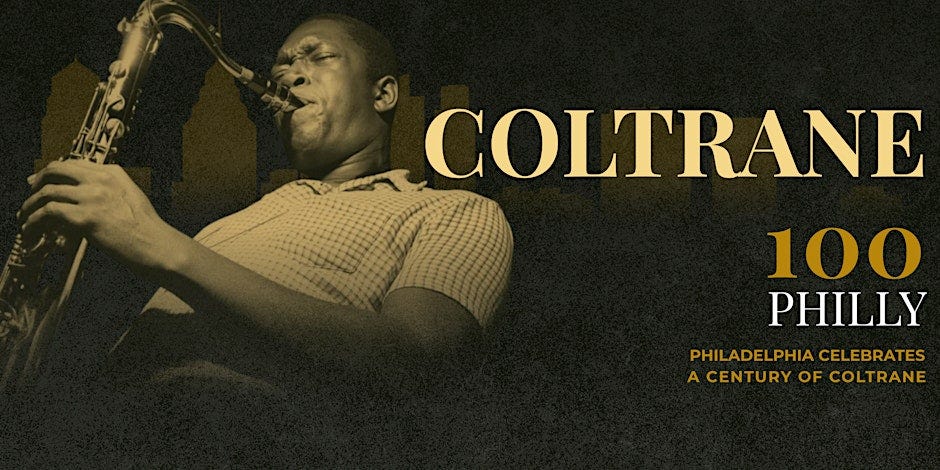
Coltrane 100 Philly is now official, the John Coltrane House is opening its doors to the public for the first time, and this city is about to have one of the most remarkable fall music seasons in its history.
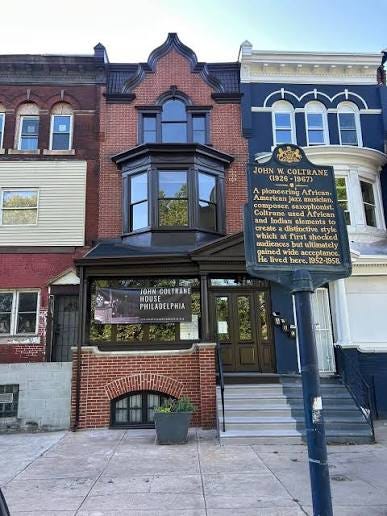
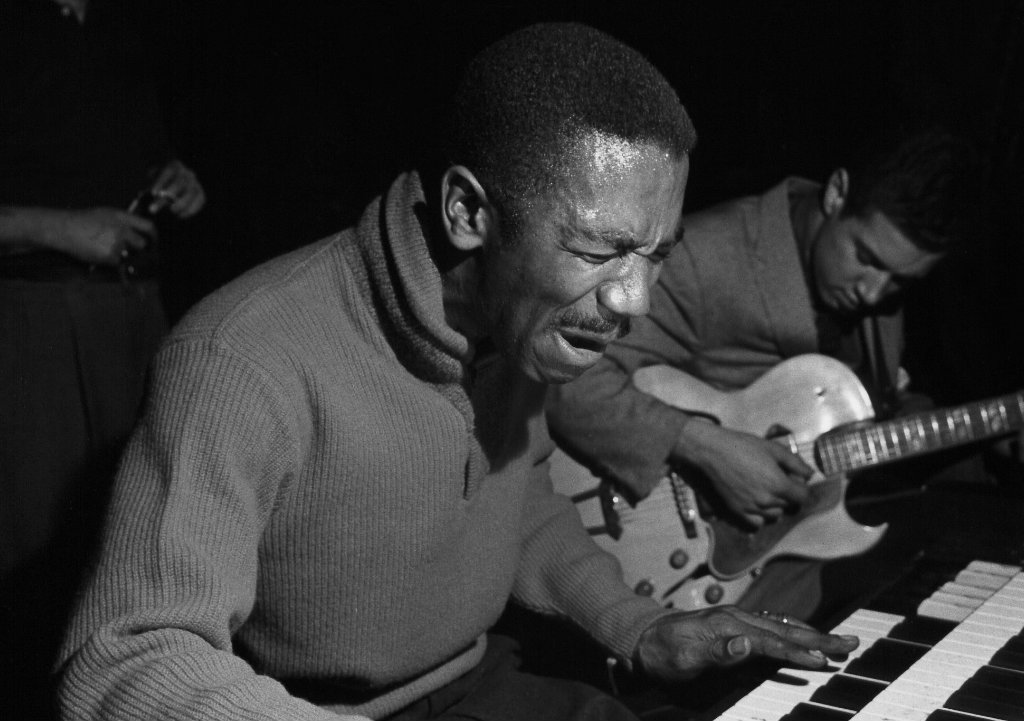
Philadelphia has a complicated relationship with its own greatness. The city that shaped John Coltrane, the city where he bought his house on North 33rd Street in 1952 and spent years working from sideman to one of the defining musical minds of the 20th century, has not always treated that legacy with the visibility it deserved. That changes this fall. On July 23, 2026, at the Yard on John Coltrane Street, members of the Coltrane family joined civic leaders, cultural organizations, and artists to officially launch Coltrane 100 Philly, a citywide centennial celebration honoring the 100th year since Coltrane’s birth. More than 30 performances, community events, educational programs, and artist grants will roll through the city between now and year’s end, and the season opens with one of the most significant pieces of historic preservation news Philadelphia has seen in years: the John Coltrane House at 1515 North 33rd Street is opening to the public for the first time in 2026, activated as a living cultural site by the Coltrane Estate in partnership with Ars Nova Workshop. Read The Improv Cafe’ Substack!
What Coltrane 100 Philly Actually Is — and Why It Matters Beyond the Concert Schedule
The celebration was announced by State Senator Vincent Hughes, in partnership with Jazz Philadelphia, Creative Philadelphia, Ars Nova Workshop, and WRTI at Temple University. Philadelphia’s Chief Cultural Officer, Valerie V. Gay, described it plainly: “Coltrane 100 Philly is an invitation to experience our city through the music that helped define it.” That’s accurate, but it understates the historical weight. Coltrane didn’t just pass through Philadelphia. He grew up musically there. He formed his early working groups there. He absorbed the particular creative energy of a city with deep jazz roots and a community of serious musicians who pushed each other hard. He saw, as Gay put it, the possibility, the grit, and the creative spirit that Philadelphia has always offered to artists willing to work. The fall celebration is asking the city to reckon with that history and claim it. Read The Improv Cafe’ Substack!
The Events: Every Date Worth Knowing
The Coltrane 100 Philly season opened with a massive concert featuring Ravi Coltrane and The Philadelphia Orchestra at the Highmark Mann Center, and the programming that follows it across the fall is extraordinary in its range and depth.
September 5, 2026: Philadelphia percussionist and drummer Karen Smith, known as “Magic Fingaz,” performs a Coltrane-inspired tribute concert at the Philadelphia Museum of Art. Smith has spent her career at the intersection of jazz, improvisation, and community music-making, and a Coltrane tribute anchored by her particular rhythmic sensibility is exactly the kind of event that the celebration needs alongside its larger concert productions. Music and visual art in the same building, honoring the same person. Good idea. Read The Improv Cafe’ Substack!
The Tiberi Tapes: What the Archive Is Giving Us This Year
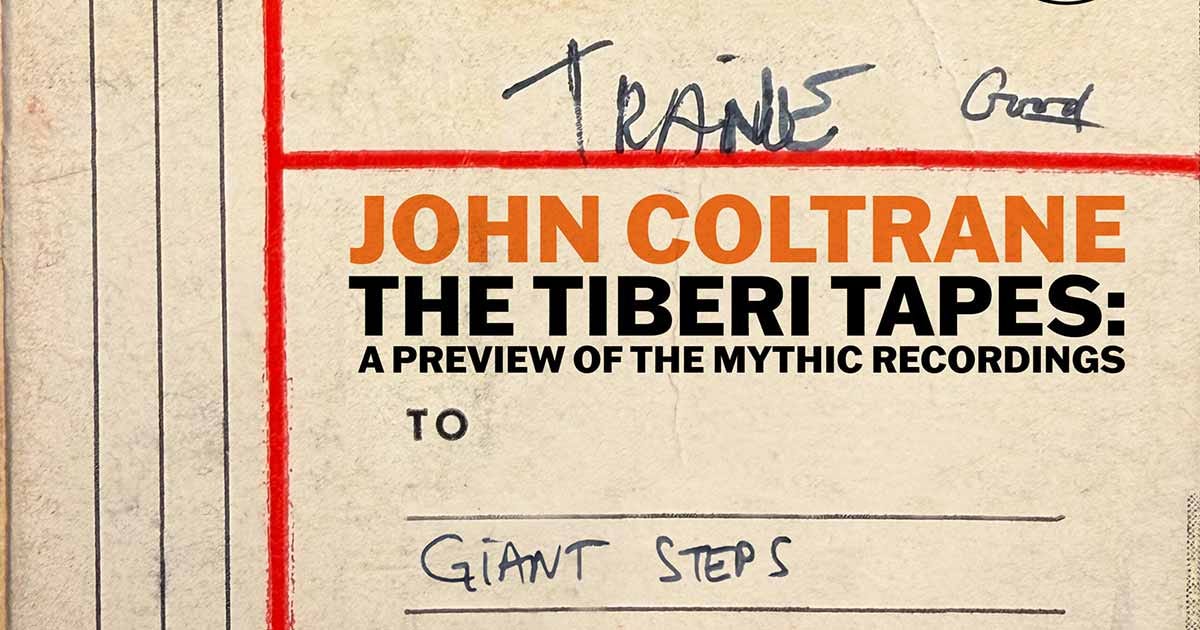
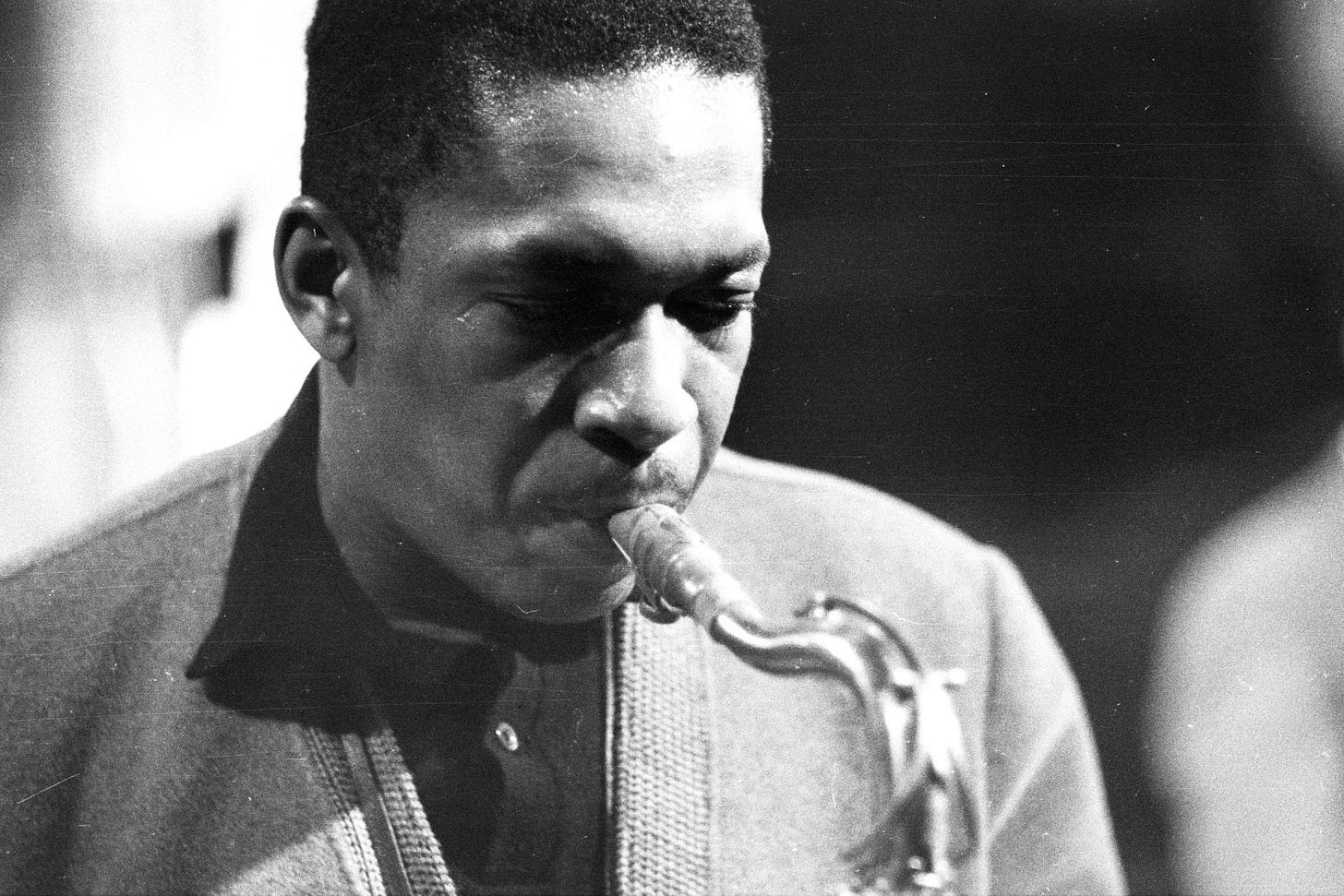
Woven through the entire Coltrane 100 celebration is the release of the Tiberi Tapes, one of the most significant archival discoveries in jazz history. These are private recordings made by musician Frank Tiberi between 1961 and 1965, capturing Coltrane in clubs in New York and Philadelphia during the period when his classic quartet, with pianist McCoy Tyner, bassist Jimmy Garrison, and drummer Elvin Jones, was doing some of the most transformative playing in jazz history. The tapes were made informally, on equipment that was not professional studio gear, and they carry the particular quality that informal documentation always does: the spontaneity of something captured because someone understood, in the moment, that what was happening was too important to let pass unrecorded. Read The Improv Cafe’ Substack!
Detroit Makes the Free Festival Even Bigger and More Focused
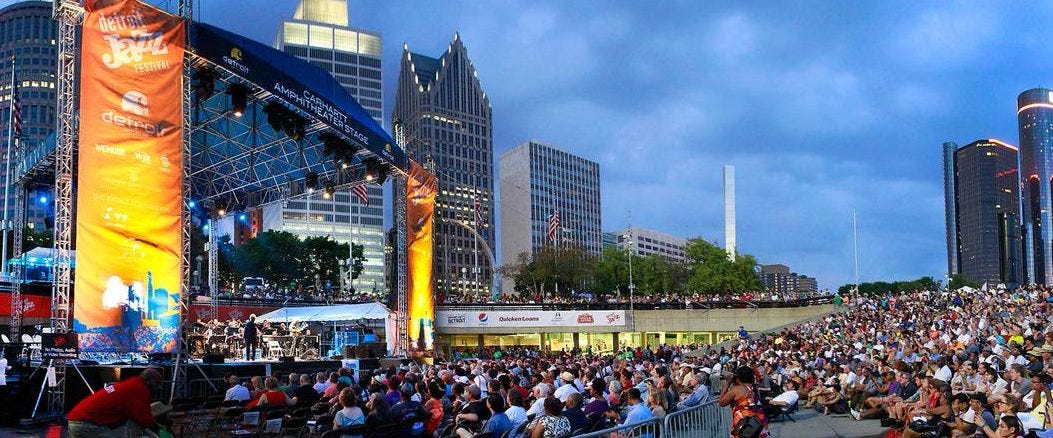
The Detroit Jazz Festival, the world’s largest free jazz festival, just announced its full lineup and a significant structural change for its 47th edition, running September 4 through 7, 2026, over Labor Day weekend at Hart Plaza in downtown Detroit. The lineup is outstanding. But the operational news is equally significant for anyone attending.
For the first time, all three of the festival’s main outdoor stages, the Carhartt Amphitheater Stage, the Pyramid Stage, and the Absopure Waterfront Stage, are being fully consolidated inside Hart Plaza. Previously, stages were spread across a wider footprint that required more walking and created logistical friction for audiences trying to catch multiple performances. The new layout places everything in one connected, walkable space, making it genuinely easier to move between sets, discover artists you hadn’t planned to see, and experience the festival as one continuous event rather than three separate areas with competing priorities. Artistic Director Chris Collins framed it directly: “At its core, jazz is about connection, and bringing the festival fully into Hart Plaza helps us deepen that connection.” Read The Improv Cafe’ Substack!
New Releases That Every Serious Jazz Listener Should Know
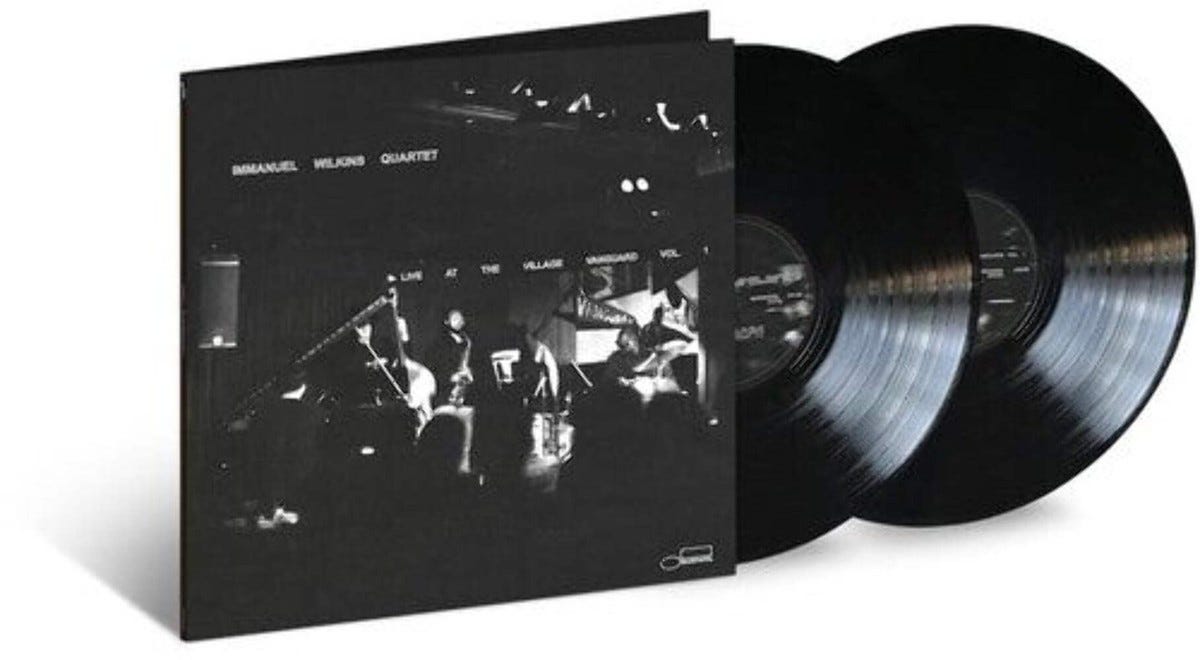
Immanuel Wilkins: Live at the Village Vanguard, Volumes 1, 2, and 3. This is the most important live jazz release of 2026 so far, and it isn’t particularly close. The Grammy-nominated alto saxophonist recorded his first-ever live album at the Village Vanguard in 2025 with his quartet: pianist Micah Thomas, bassist Ryoma Takenaga, and drummer Kweku Sumbry. Blue Note released Volume 1 on March 20, Volume 2 digitally on April 17, and Volume 3 on May 15, spreading the full document across three installments that together constitute what Jazzwise described as a significant entry in the tradition of seminal live recordings made within those same walls. Read The Improv Cafe’ Substack!
Gabrielle Cavassa, “Diavola,” Blue Note Records. Best known as a touring vocalist alongside Joshua Redman, Cavassa has now launched her solo recording career with a debut album on Blue Note, and the early response has been significant. Her voice carries the kind of specificity and emotional directness that separates jazz vocalists who are genuinely extending the tradition from those who are simply singing jazz songs well. “Diavola” is an album worth your time. Read The Improv Cafe’ Substack!
Montclair Says Something Important About What Free Jazz Can Be
The Montclair Jazz Festival staged its Soundcheck concert series this month with Joel Ross and Good Vibes headlining a free outdoor tribute dedicated to Chicago’s historic jazz legacy. Ross, the vibraphonist who has been quietly building one of the most compelling bodies of work in contemporary jazz for the past several years, is exactly the kind of artist that a well-run festival presents not because the name is a guaranteed ticket seller but because the music is serious and worth an audience’s attention. Free outdoor jazz in a New Jersey city that has committed to its summer music series is one of the most underappreciated live music experiences in the region, and Joel Ross headlining it is not a minor event. Read The Improv Cafe’ Substack!
Maui Comes Back — and Brings Something Larger Than a Concert
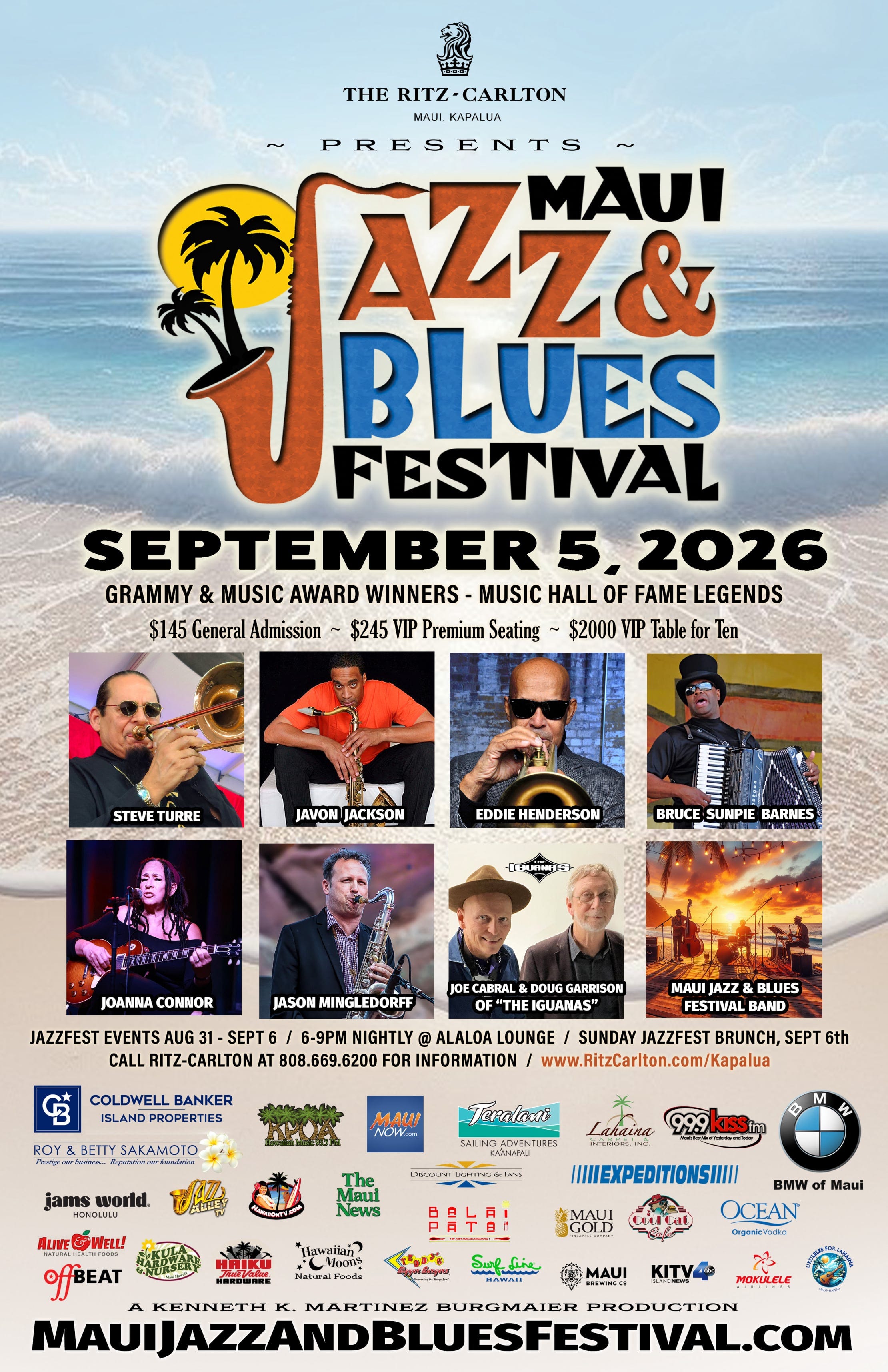
The Maui Jazz and Blues Festival is returning to the Ritz-Carlton in Kapalua after the Lahaina wildfires upended the community and the cultural calendar that had made Maui a genuine music destination. The festival’s decision to donate hundreds of free tickets to wildfire survivors is not a marketing decision. It’s a statement about what live music festivals are actually for: not just entertainment delivery systems, but community institutions that belong to the communities they come from. When a place has suffered the way Lahaina did, the return of something as seemingly simple as a jazz festival outdoors with the Pacific visible from the stage carries weight that is difficult to articulate and easy to feel. Maui is back. The music is back. That matters. Read The Improv Cafe’ Substack!
This Is What We Broadcast. This Is Why We Do It.
Coltrane bought that house on North 33rd Street in 1952 and spent years working in the Philadelphia jazz community while he transitioned from a reliable sideman into one of the most original musical voices the world had produced. That transition happened, at least partly, because Philadelphia gave him a community, a set of peers, and a creative environment that pushed him. The city shaped the sound. The sound changed everything. And now, in 2026, the city is finally giving that story the full public celebration it has always deserved.
At The Improv Café, we broadcast the music that Coltrane and his contemporaries made live. Every track on this station came from a stage, a club, a university concert hall, an outdoor festival. The Tiberi Tapes being released this fall are exactly the kind of document we celebrate. Live recordings made in real rooms by musicians playing without the safety of a controlled studio environment. The music as it actually was, not a reconstruction of what it might have sounded like. This fall, Philadelphia and Detroit and Montclair and Maui are all saying something true about live music: it’s not optional, it’s not a supplement to the recorded version, and it’s not nostalgia. It’s the form. It’s where everything that matters about jazz happens first. Tune in to The Improv Café and hear it broadcast, every night, exactly as it was played.
The Stories Every Serious Jazz Listener Needs to Know Right Now
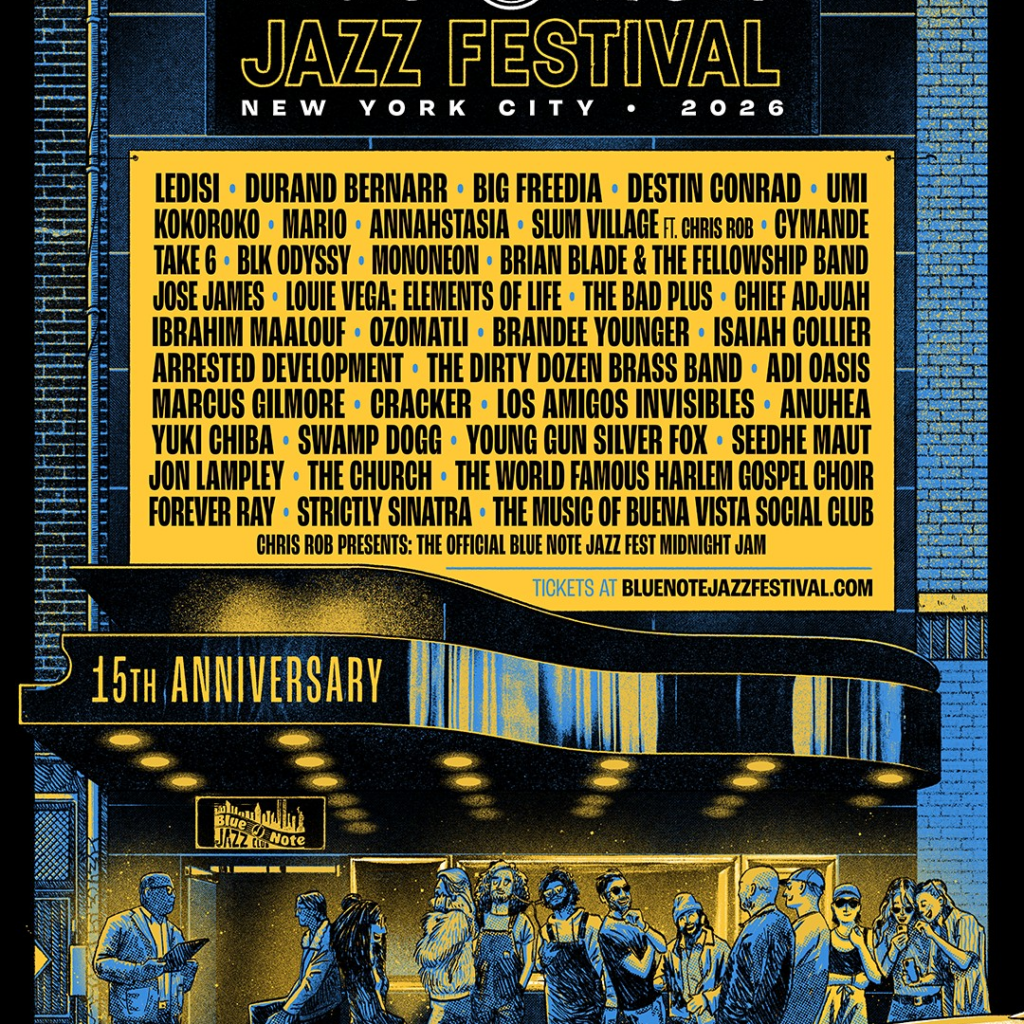
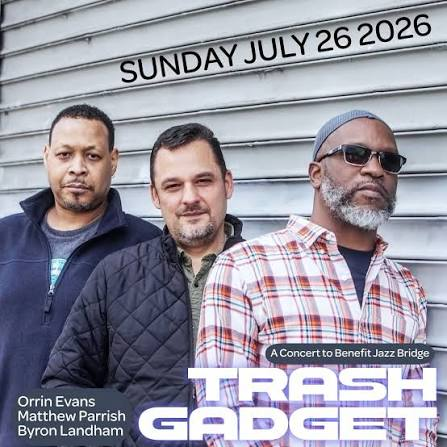
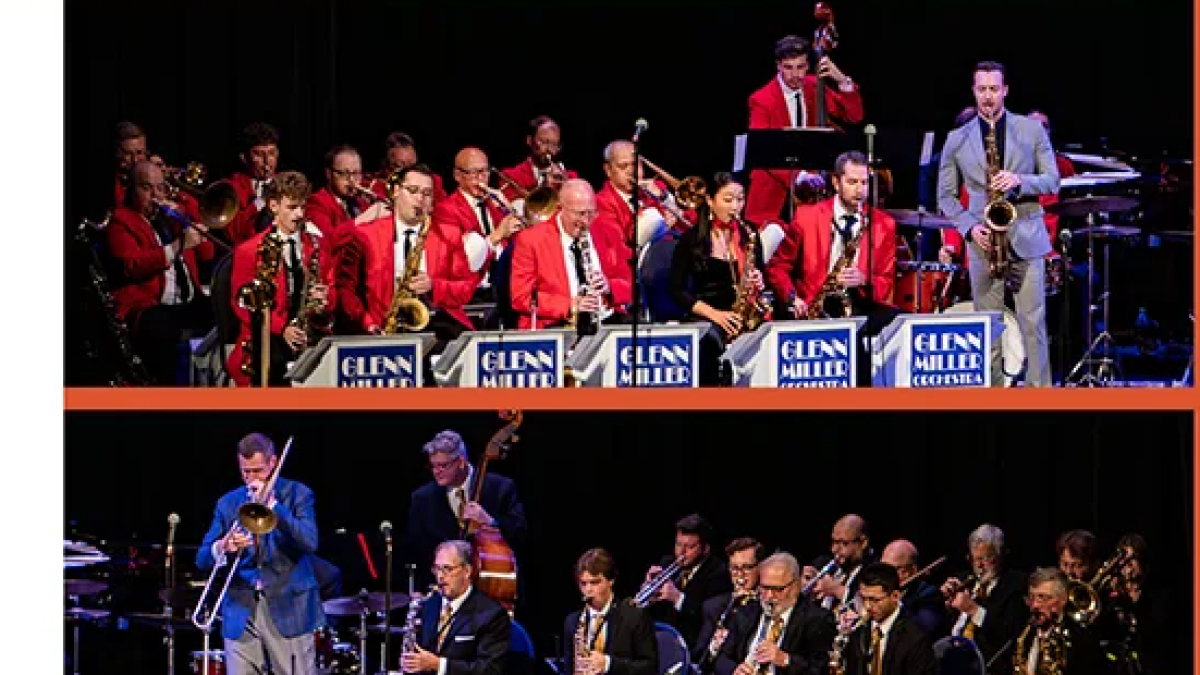
There is a different kind of jazz news cycle running below the surface of the standard festival calendars and streaming chart headlines, and this week it is particularly rich. The 2026 Newport Jazz Festival is completely sold out with a fan-to-fan ticket exchange system now running as the only legal option for latecomers. The 15th annual Blue Note Jazz Festival New York has unveiled a lineup that is genuinely redefining what a jazz festival can be in scope and genre range. A legendary Philadelphia pianist is reuniting with two long-term musical partners for a charity performance this Sunday that jazz purists in the Delaware Valley should treat as a calendar priority. The Village Vanguard is moving from one extraordinary residency directly into another, with Makaya McCraven taking over the bandstand this week through August 2. And the Glenn Miller Orchestra and the Tommy Dorsey Orchestra have locked in a co-headlining fall tour that will bring two of the most historically significant big bands in the world to the same stage, alternating classic swing charts in what promises to be one of the most electrifying live jazz events of the autumn season. At The Improv Café, the radio station that only plays live Jazz, live Big Band, and live Swing, all of this is our world. Here is everything you need to know. Read the full articles on The Improv Cafe”s Substack!
Newport Jazz Festival 2026: Every Ticket Gone, and Here Is What to Do About It
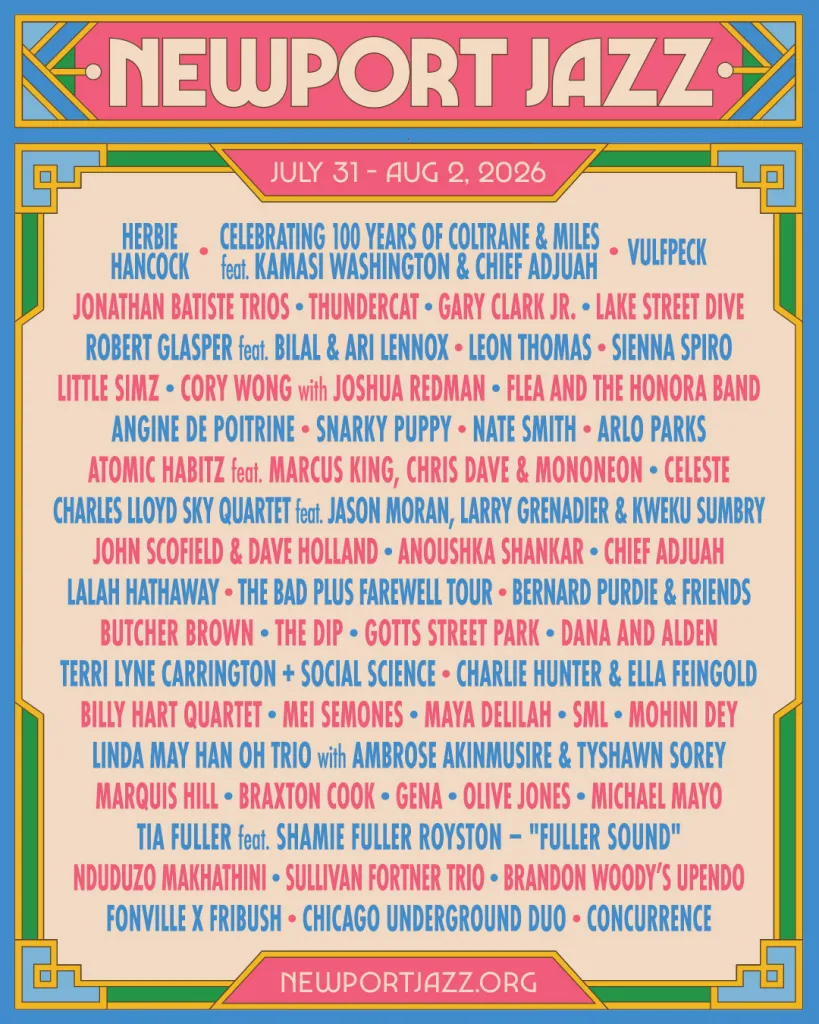
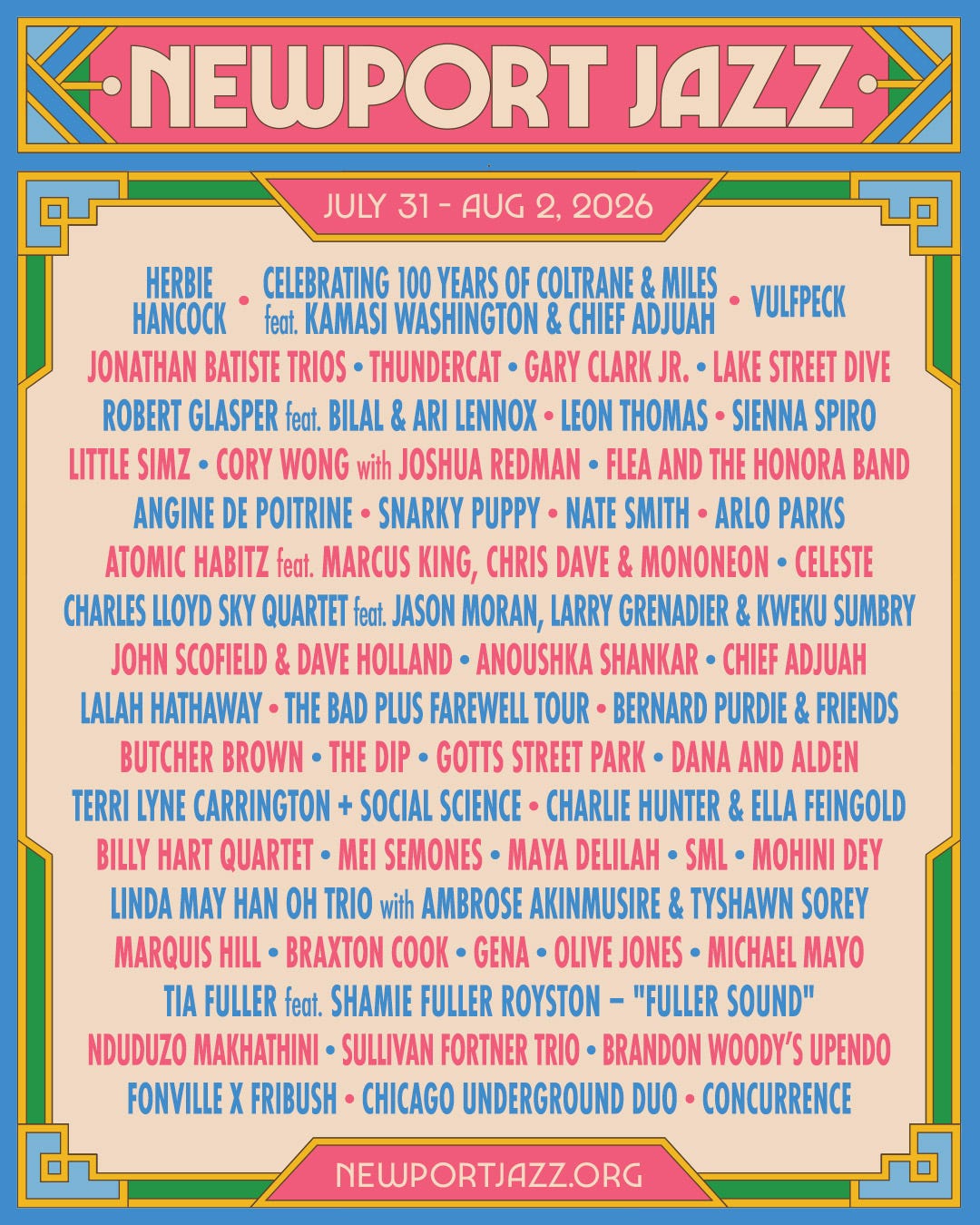
The 72nd annual Newport Jazz Festival runs July 31 through August 2, 2026, at Fort Adams State Park in Newport, Rhode Island, and the news arriving from the festival office this week is unambiguous: every single ticket for all three days is completely sold out. General admission passes, student vouchers, Jazz Lounge packages, and single-day tickets are all gone. This is the fourth consecutive sold-out Newport Jazz Festival, and it reflects something significant about where the appetite for live jazz sits in 2026. These are not small numbers. The festival fills Fort Adams with attendees over three days, in an outdoor setting with limited access, and demand has now outstripped capacity for years running. Read the full articles on The Improv Cafe”s Substack!
The 15th Annual Blue Note Jazz Festival New York: A Lineup That Is Rewriting the Rules
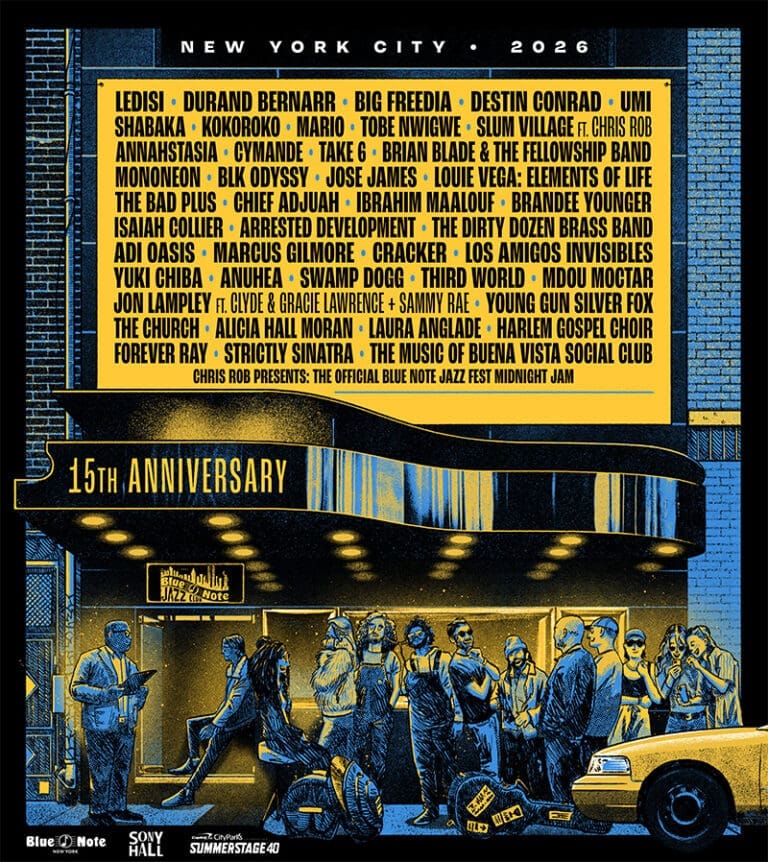
When the Blue Note Entertainment Group unveiled the lineup for the 15th annual Blue Note Jazz Festival New York earlier this year, the reaction from inside the jazz world was immediate and pointed. This was not a conventional jazz festival bill. It was not even a conventional jazz-adjacent festival bill. It was a curatorial statement about what a music festival organized around jazz’s values, rather than jazz’s genre boundaries, looks like when it is built by people who genuinely understand the music and its connections to everything that grew from it. Listen to the Live at The Blue Note Radio Show Weekly on Wednesdays!Read the full articles on The Improv Cafe”s Substack!
This Sunday in Philadelphia: A 30-Year Reunion You Should Not Miss
For listeners in the Philadelphia region who want a live jazz experience that exists entirely outside the festival circuit, this Sunday, July 26, 2026, brings something extraordinary to SOUTH Restaurant and Jazz Club at 600 N. Broad Street in Philadelphia. The performance begins at 6:00 PM, and it is the kind of evening that jazz purists recognize on sight and rarely get to witness. Read the full articles on The Improv Cafe”s Substack!
The Village Vanguard: Two Residencies That Define the Current Moment
The Village Vanguard in New York’s West Village is perhaps the most storied jazz venue in the world, the basement room where John Coltrane, Bill Evans, Miles Davis, and a hundred other architects of the music created the recordings that defined entire periods of jazz history. Right now, the Vanguard is hosting one extraordinary artist closing out a run this weekend and another taking over the bandstand immediately after, and together the two residencies represent the full range of what serious, forward-looking live jazz sounds like in 2026. Listen to the Live at The Village Vanguard Radio Show Weekly on Tuesdays!Read the full articles on The Improv Cafe”s Substack!
The Battle of the Big Bands: Glenn Miller vs. Tommy Dorsey This Fall
For listeners whose live jazz interest extends into the world of swing era orchestras and the great big band tradition, the most significant scheduling news of the coming months is the confirmed fall tour co-headlining engagement between the Glenn Miller Orchestra and the Tommy Dorsey Orchestra, billed as the Battle of the Big Bands. The two ensembles will share a single stage, alternating full orchestra sets and engaging in live horn-section exchanges that recreate the competitive energy of the 1930s swing ballroom era, when competing orchestras and their devoted fan bases made dance hall popularity a genuine contest of musical prestige. Listen to the Swing with the Bands Radio Show Weekly on Friday Nights!Read the full articles on The Improv Cafe”s Substack!
Josh Lee and the Extended Family: Philadelphia’s Next Big Band Voice
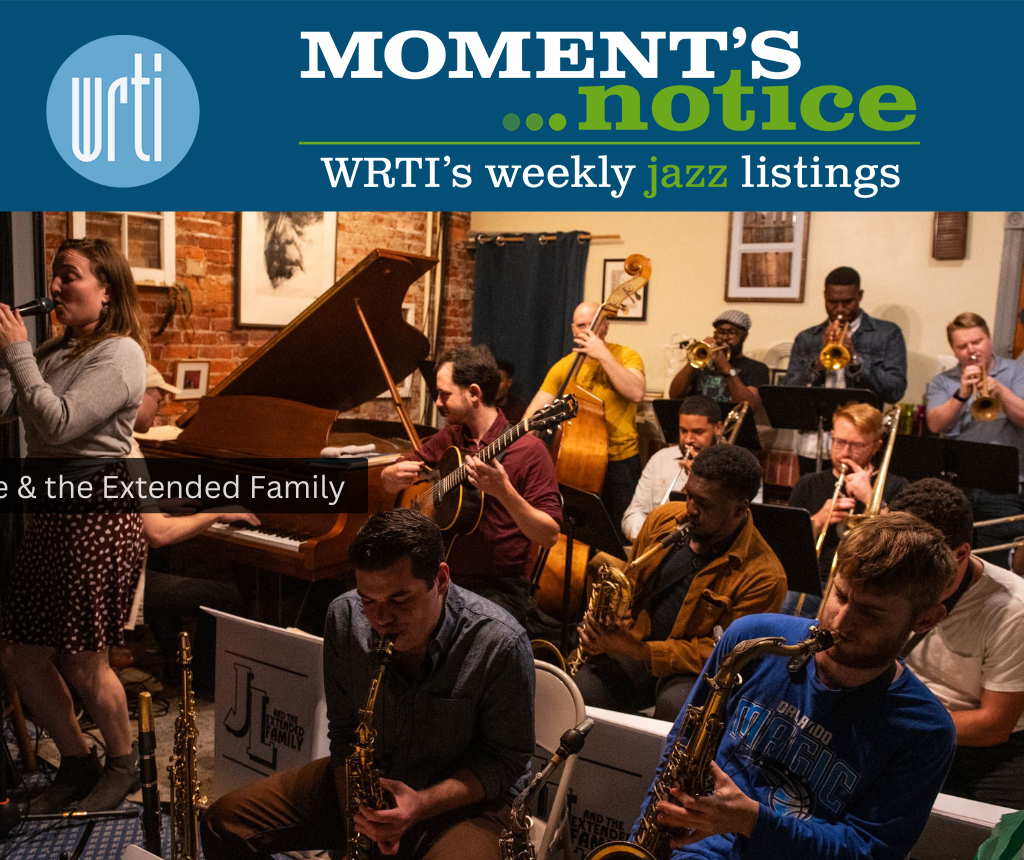
For listeners who want to track emerging big band talent at the local level, Philadelphia baritone saxophonist and arranger Josh Lee is the name to know. A Grammy-winning arranger and active member of the legendary Count Basie Orchestra, Lee has expanded the lineup for his own ensemble, Josh Lee and the Extended Family, a 14-piece big band composed entirely of the most accomplished young horn players in the Philadelphia area. The ensemble has been generating serious attention for a commitment that is increasingly rare in contemporary big band circles: a deliberate and rigorous focus on the Kansas City swing tradition of the 1920s and 1930s, specifically the rhythmic approaches of Bennie Moten and Jimmie Lunceford, two figures whose contributions to American swing are foundational but often overshadowed by the names that followed them into the mainstream. Josh Lee and the Extended Family have been added to a curated fall showcase through Jazz at Lincoln Center, which represents both a significant milestone for the ensemble and a recognition from one of the world’s most respected jazz institutions that what Lee is doing with this band is worth bringing to a wider audience. Read the full articles on The Improv Cafe”s Substack!
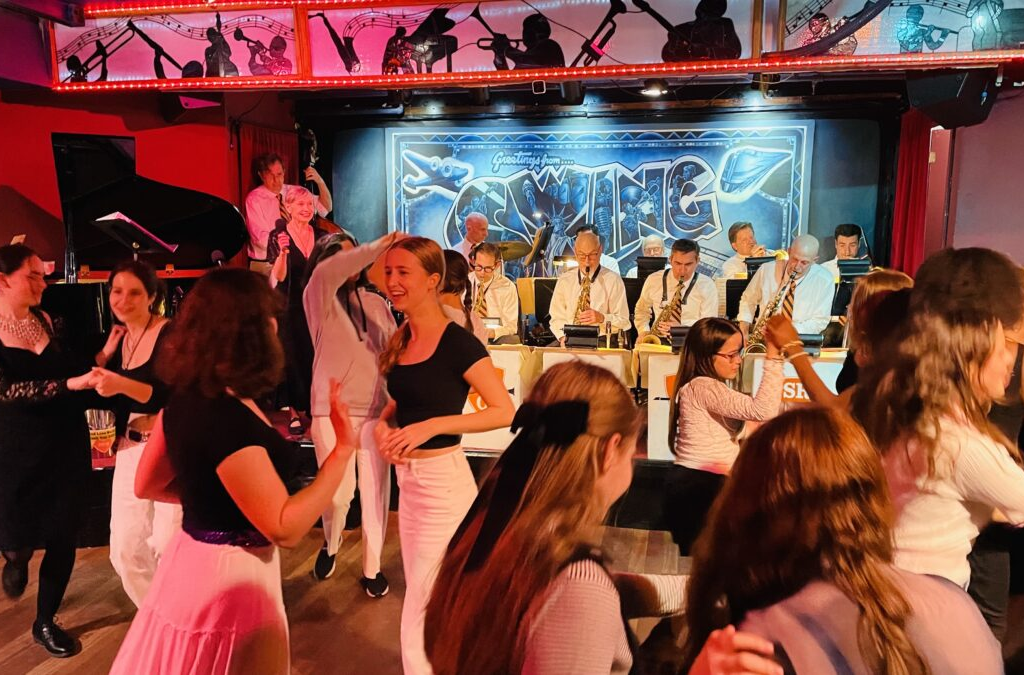
Midtown Manhattan: Seven Nights a Week of Live Big Band at SWING46
In New York City, the iconic SWING46 Jazz and Supper Club on Restaurant Row in Midtown has completed its return to a full live performance schedule, confirming seven nights a week of live big band music with complimentary dance lessons offered to all patrons. The weekly residency rotation brings four distinct ensembles to the SWING46 stage, each with its own character and musical approach within the swing tradition. Mondays belong to Swingadelic. Tuesdays feature the George Gee Swing Orchestra, one of the most consistent and celebrated live swing ensembles in New York. Wednesdays bring the Stan Rubin Swing Era Big Band, rooted in the repertoire and feel of the classic period. Thursdays are held by the Harlem Renaissance Orchestra, whose programming draws from the full arc of the Harlem big band tradition. For anyone in or visiting New York through the summer and fall, SWING46 represents one of the clearest expressions of what The Improv Café broadcasts every night: live big band music, performed for dancers and listeners alike, in an intimate setting where the orchestra fills the room and the music does exactly what swing was always designed to do. Listen to the Swing with the Bands Radio Show Weekly on Friday Nights!Read the full articles on The Improv Cafe”s Substack!
What All of This Means for The Improv Café’s Listeners
Every story in this issue is a story about live music and why it matters in a way that recorded, studio-produced music never fully can. Newport is sold out because the demand for live jazz in an outdoor setting under the Rhode Island summer sky exceeds what Fort Adams can hold. The Blue Note Jazz Festival New York ran 52 concerts across 30 days because the appetite for live jazz of every kind, from avant-garde instrumentalists to New Orleans brass bands to R&B vocalists whose work is rooted in jazz tradition, is exactly that deep. A trio of Philadelphia jazz veterans who have not shared a formal stage in years is performing this Sunday for a charity that supports working musicians in crisis, and the room will be full because the jazz community in this city still shows up for the real thing. Makaya McCraven is performing six consecutive nights at the Village Vanguard because the Vanguard knows, and has always known, that what happens in that room when the right musician is on the bandstand cannot be replicated anywhere else. And the Glenn Miller Orchestra and the Tommy Dorsey Orchestra are putting two 15-piece ensembles on the same stage this fall because the sound of live swing at full orchestral scale is still, in 2026, something that audiences will travel to experience.
This is the world that The Improv Café broadcasts. Not a version of it, not a digital approximation, but the actual music, captured live, in real rooms, at real moments, and shared with listeners who understand that the live performance is where jazz has always lived and where it always will. Tune in.
The Improv Café — Live Jazz. Live Big Band. Live Swing. All live. Every song. Every night.
The Live Music World Is Moving Fast Right Now — and The Improv Café Is Right Here with Everything You Need to Know
Global Jazz: The World Is Listening and Streaming Live
There is a particular energy that surrounds the live jazz world in the middle of summer, when the festival season is at full volume, when venues from London to Madrid to Camden County’s waterfront are programming back-to-back nights of extraordinary music, when new releases are arriving alongside major concert announcements, and when the distance between the global stage and your own backyard feels remarkably small. That energy is exactly what defines this moment in July 2026. From a landmark global broadcast partnership for one of the world’s most distinctive fusion groups, to a jazz supergroup show happening right here in the Philadelphia and South Jersey region next month, to a Grammy-winning saxophonist bringing progressive Puerto Rican jazz to a free riverfront stage, the live music landscape right now is as rich and as geographically close as it has been all year. Read The Story on The Improv Cafe’ Substack!
Global Jazz: The World Is Listening and Streaming Live
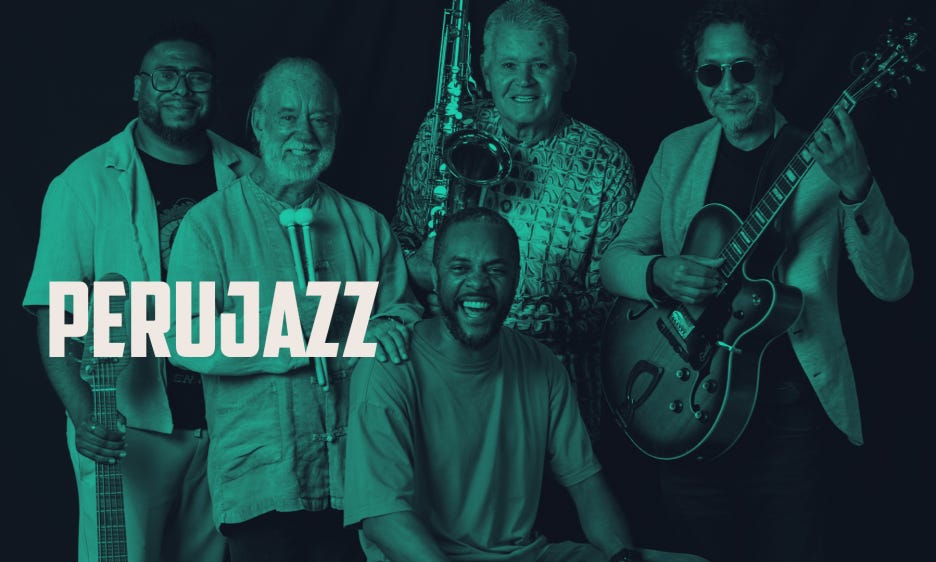
Perujazz Takes the Stage in Madrid, Reaches the Entire World
One of the most compelling stories in the current global jazz landscape is the formal partnership between Perujazz, the legendary avant-garde fusion ensemble, and the Oh! Jazz worldwide streaming network, which broadcast the group’s high-profile live set from Madrid directly to international audiences. That broadcast is now archived and available for on-demand streaming globally, which means that a performance rooted in Afro-Peruvian rhythms, Andean musical traditions, and the full creative vocabulary of modern jazz improvisation is now accessible to listeners on every continent who may never have encountered this music before. Read The Story on The Improv Cafe’ Substack!
London’s New Platform for Experimental Jazz
Across the channel in London, MjR, one of British jazz’s most respected promoters, officially launched the Midnight Station Live Showcase Series across the city’s most dynamic venues. The series is designed specifically to spotlight rising experimental and progressive jazz artists, giving a structured, recurring platform to the kind of music that is most often encountered only in one-off bookings or informal sessions. A dedicated showcase series changes the equation entirely. It creates a destination for listeners, a calendar artists can plan around, and a consistent identity that builds audience over time. For the London jazz scene, which already has one of the deepest and most creative communities of jazz musicians anywhere in the world, the Midnight Station Series arrives at exactly the right moment, when new voices are coming through in extraordinary numbers and the infrastructure to present them properly is the essential missing piece. This series provides that infrastructure, and the live jazz world across the UK is watching closely. Read The Story on The Improv Cafe’ Substack!
Montreal’s 46-Year Archive Opens Its Doors
The Montreal International Jazz Festival, which just concluded its monumental 46th edition in the Quartier des Spectacles, has now released a major archival series drawing from nearly half a century of live performances captured at the festival. The collection includes rare broadcast audio from artists of the stature of Miles Davis and Diana Krall, performances that represent not just the history of those individual artists but the history of the festival itself and its role in defining what live jazz documentation could mean in the era of broadcast radio and digital streaming. For listeners who encountered the Montreal festival for the first time at its 46th edition, this archive is a doorway into everything that made the festival what it is. For long-time followers of the event, it is a chance to return to performances they experienced in person and hear them with fresh ears. For historians of the music, it is an invaluable resource. And for The Improv Café, it is further evidence that the live jazz recording is never simply a souvenir. It is the record of what happened, and what happened at Montreal over 46 years is some of the most important jazz ever performed anywhere. Read The Story on The Improv Cafe’ Substack!
Domestic US Jazz News: The Stories Reshaping the American Scene
Dinner Party at Heuser Park: The Jazz Supergroup That Belongs in Your Summer
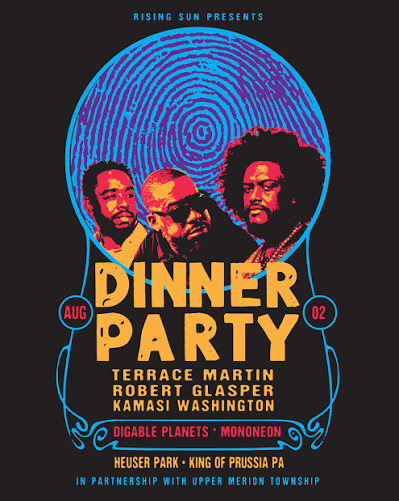
The single most exciting concert announcement in the Philadelphia and South Jersey region right now, and one of the most anticipated live jazz events of the summer anywhere on the East Coast, is Dinner Party headlining the Heuser Park outdoor stage in King of Prussia, Pennsylvania on Sunday, August 2, 2026. Doors open at 4:00 PM and the show begins at 5:00 PM, and the bill is extraordinary. Read The Story on The Improv Cafe’ Substack!
Denver Jazz Fest Closes Its Centennial Chapter
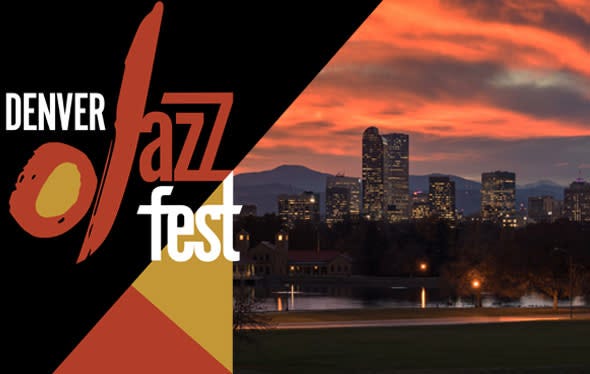
The Denver Jazz Fest recently concluded its headline series celebrating the centennial births of Miles Davis and John Coltrane, with live tribute performances from pianist John Beasley and trumpeter Marquis Hill that drew some of the most enthusiastic responses of the festival’s recent history. Beasley, who played with Miles Davis in the late 1980s and whose “Unlimited Miles” tour has been one of the most discussed centennial projects of 2026, brings a direct personal connection to the Davis legacy that no amount of scholarship can replicate. Hill, one of the most compelling trumpet voices working in jazz today, represents the next generation’s engagement with the Coltrane tradition, connecting the centennial to its living future rather than merely celebrating its past. The Denver festival’s decision to anchor its 2026 centennial programming around live tribute performance rather than lecture or documentary reflects exactly the right understanding of how these legacies are best honored, through musicians playing the music in front of audiences, live, in real time. Read The Story on The Improv Cafe’ Substack!
Seattle’s New Voice in Grunge and Jazz
One of the more surprising and genuinely creative stories in domestic jazz right now comes from the Pacific Northwest, where saxophonist Cliff Colon and organist Jake Sele have launched a new live project that is generating attention well beyond Seattle. Their concept is as simple to state as it is audacious to execute: take the defining rock songs of 1990s Seattle, the catalog of Nirvana and Pearl Jam and the broader grunge era, and translate them through the language of organ-driven avant-garde jazz. The results, by all accounts from those who have heard the early performances, are neither novelty nor pastiche. Colon and Sele are serious jazz musicians engaging seriously with music they grew up with, and the encounter between the raw emotional directness of grunge and the improvisational vocabulary of organ jazz produces something that illuminates both traditions without diluting either. Pacific Northwest grunge and West Coast jazz have always shared roots in the same independent, anti-commercial spirit that drove both scenes, and the Colon-Sele project makes that connection audible in a way that feels both surprising and inevitable. Read The Story on The Improv Cafe’ Substack!
South Jersey and Philadelphia: The Best of Live Jazz Close to Home
The Willingboro Jazz Festival Returns for Its 43rd Year
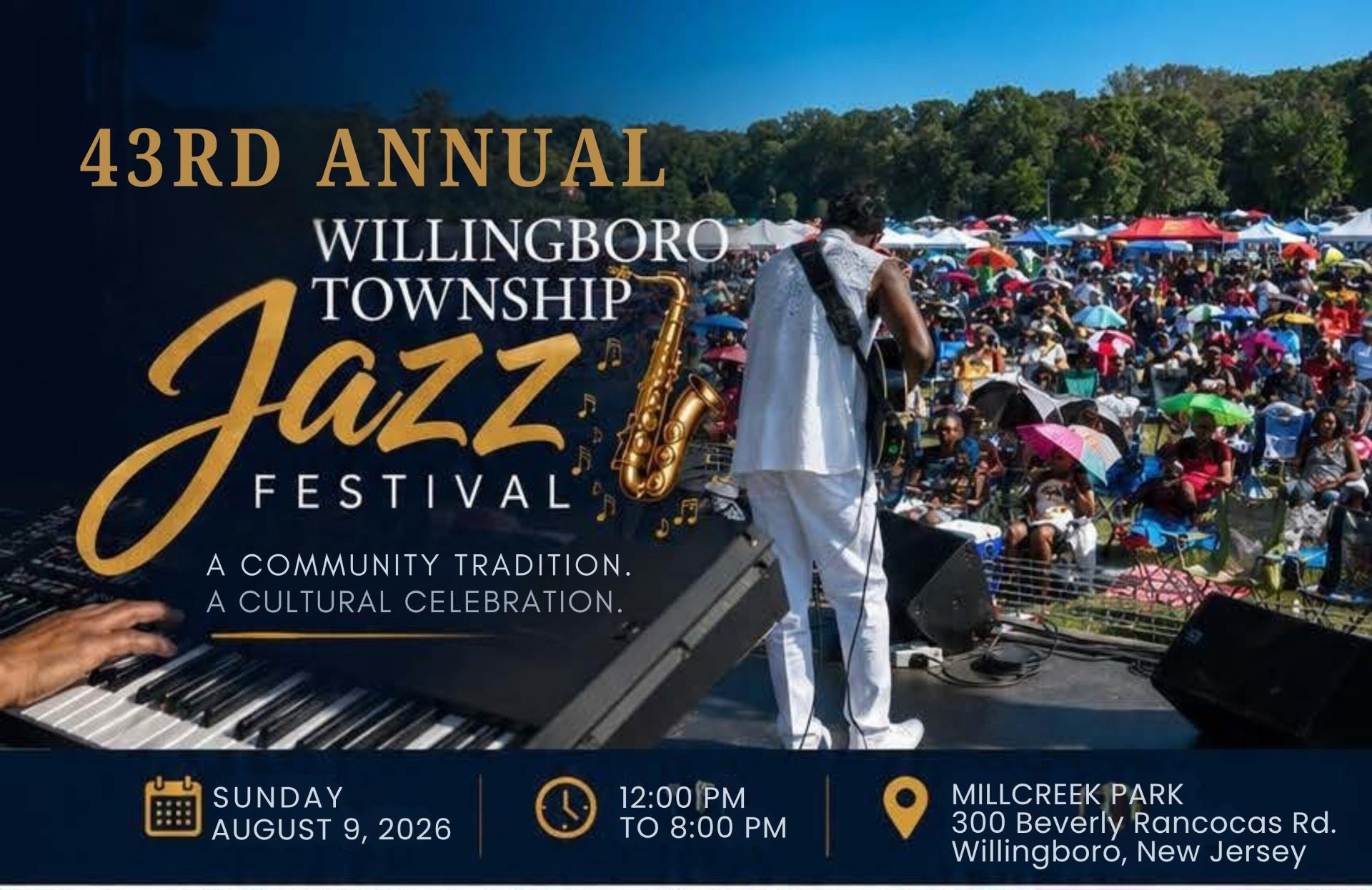
The 43rd Annual Willingboro Jazz Festival has finalized its scheduling and is preparing to take over Mill Creek Park with a multi-stage lineup that reflects the festival’s long tradition of bringing high-quality live jazz to the South Jersey community. Now in its 43rd year, the Willingboro Jazz Festival is one of the most enduring community jazz events in the entire Delaware Valley region, a festival that has maintained its commitment to live performance and community engagement across four decades while the landscape of live music around it has changed enormously. A multi-stage outdoor jazz festival in a park setting is one of the purest expressions of what this music has always been: communal, accessible, and alive to whoever shows up to listen. Vendor applications are now open alongside the programming schedule, and the complete details are available through the festival’s official channels.
Miguel Zenón Quartet at the Wiggins Waterfront Sunset Jazz Series
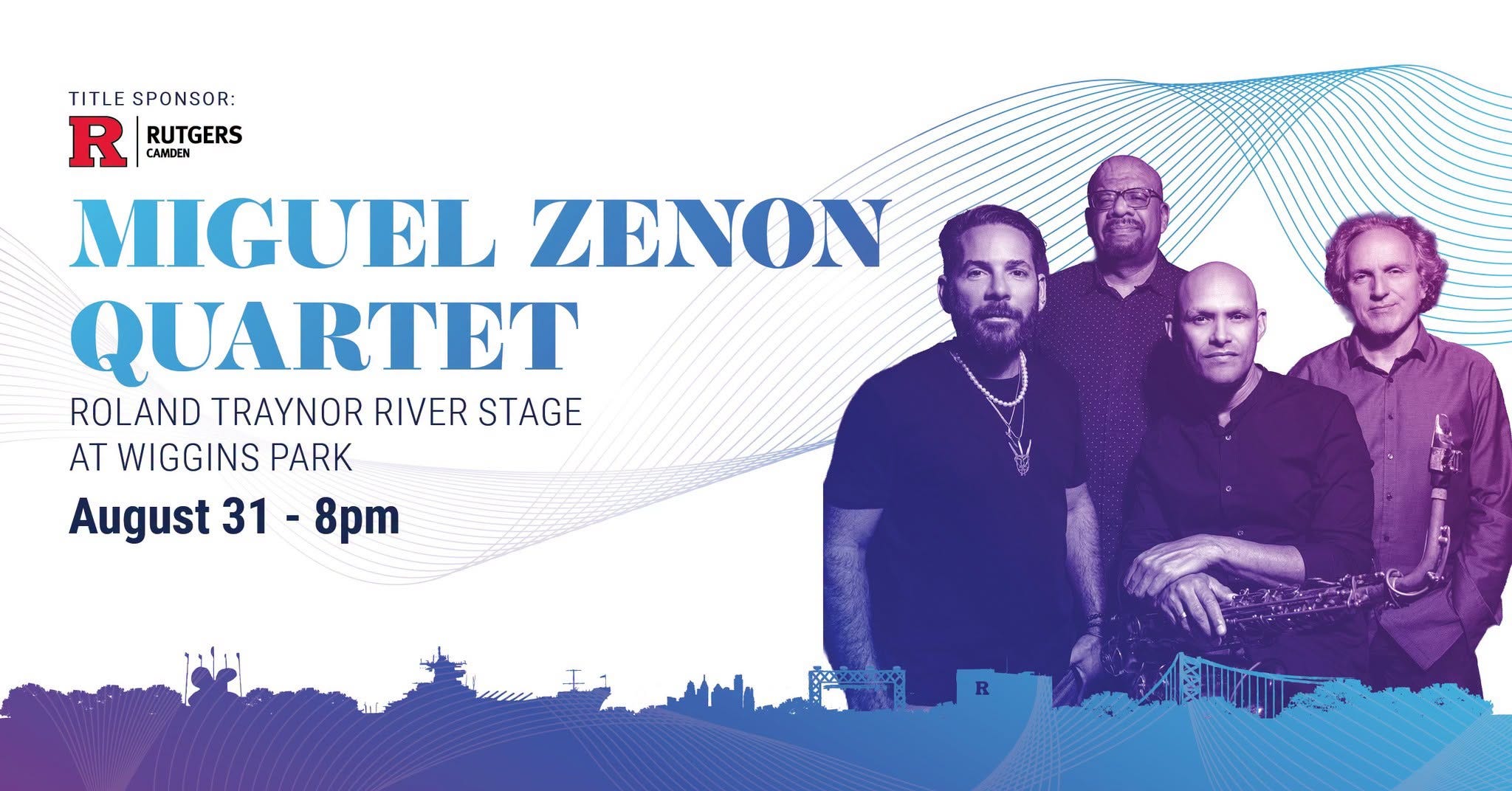
This is the announcement that every jazz listener in the South Jersey and Philadelphia area should mark on their calendar immediately. Miguel Zenón, the alto saxophonist and composer who received a MacArthur “Genius” Fellowship in 2008, who holds a Grammy Award for El Arte Del Bolero Vol. 2 (2023), who was Grammy-nominated for Vanguardia Subterránea: Live at The Village Vanguard in 2025, and who is a permanent faculty member at both the New England Conservatory and the Manhattan School of Music, is bringing his quartet to the Wiggins Park riverfront stage on the Camden City Waterfront on Monday, August 31, 2026, as part of the Sunset Jazz Series presented by Rutgers University, Camden. The concert begins at 8:00 PM and is free and open to the public. Read The Story on The Improv Cafe’ Substack!
Chris’ Jazz Café: The Keith Chasin Quintet and Hailey Brinnel
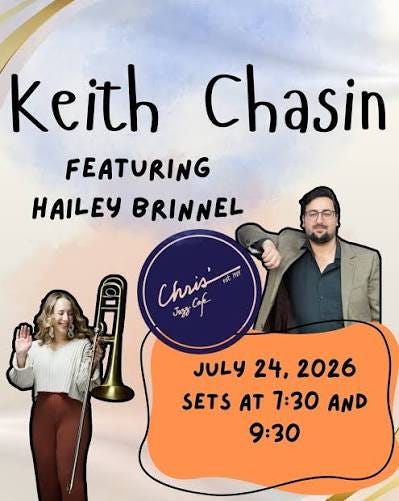
Chris’ Jazz Café in Philadelphia, one of the great intimate jazz rooms on the East Coast and a venue with a history of presenting serious jazz to serious Philadelphia audiences, has announced an upcoming double-set featuring The Keith Chasin Quintet collaborating with rising jazz vocalist Hailey Brinnel. Chris’ Jazz Café has always been a room where the music and the listener are in direct, unmediated contact, where the intimacy of the space makes every performance feel immediate and present in a way that larger venues cannot replicate. A quintet performing alongside a vocalist in a room of that scale, with the full improvisational vocabulary that a quintet brings and the expressive range that Brinnel represents, is exactly the kind of live jazz night that Chris’ was built for. The complete details and ticketing information are available through the venue directly, and this is the kind of performance that fills up quickly once the Philadelphia jazz community becomes aware of it. Read The Story on The Improv Cafe’ Substack!
What The Improv Café Brings to All of This
Every story in this newsletter connects to the same thing. Perujazz broadcasting live from Madrid. The Midnight Station Series giving London’s experimental jazz artists a recurring platform. Montreal opening 46 years of live performance recordings to the world. Dinner Party performing new material at Heuser Park alongside Digable Planets. Miguel Zenón bringing his quartet to the Camden riverfront for a free Monday night concert. Chris’ Jazz Café pairing a quintet and a vocalist in one of Philadelphia’s most beloved intimate rooms. All of it is live music, happening in real time, in places where musicians and audiences find each other and something genuine takes place. Read The Story on The Improv Cafe’ Substack!
The Improv Café — Live Jazz. Live Big Band. Live Swing. All live. Every song. Every night.
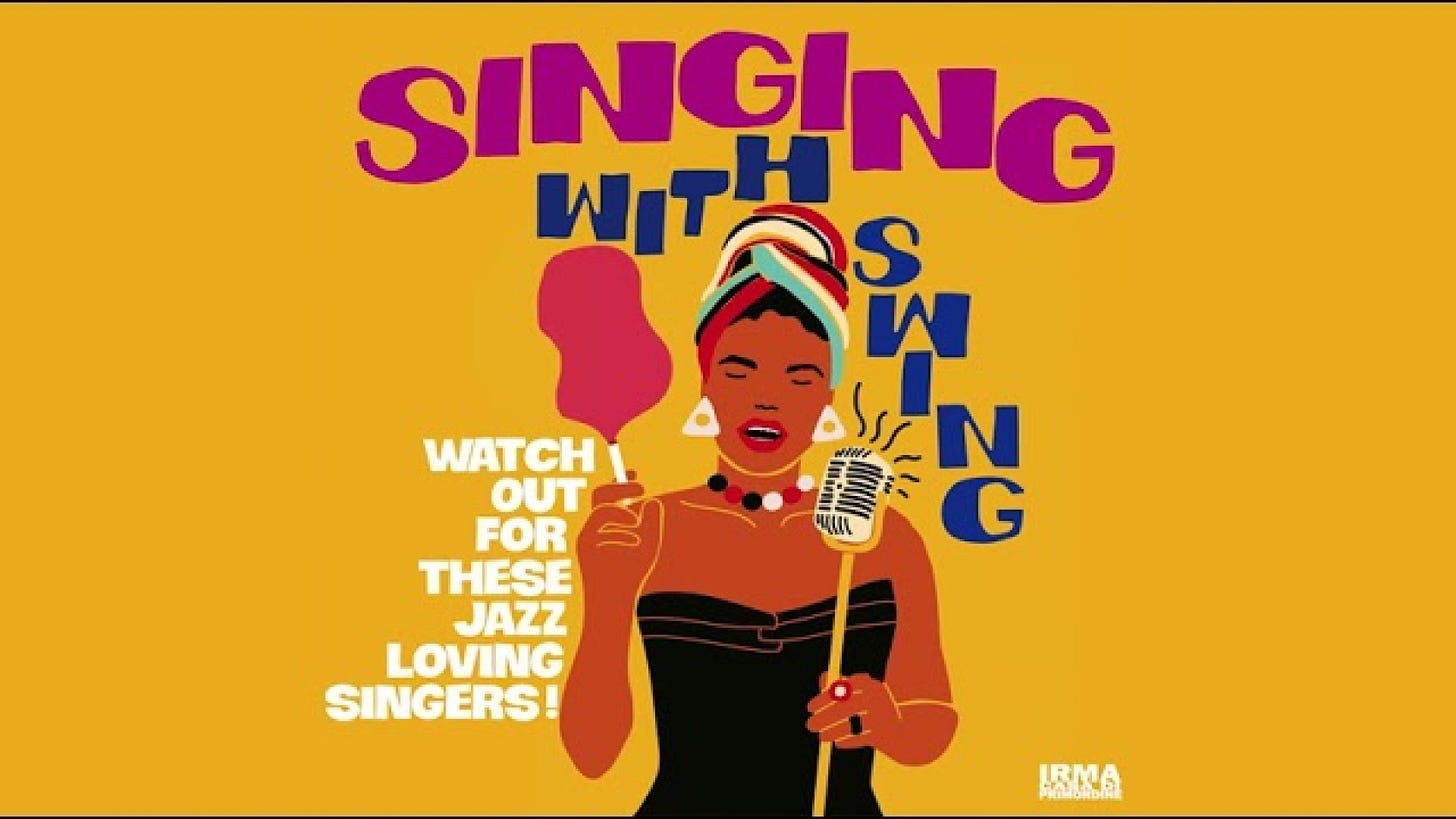
Sundays are meant for relaxation, and that’s why we have created the ‘Singing with Swing’ radio show.
This program features some of the most fantastic vocal jazz artists of our time, providing you with the perfect ambiance for a cozy night in. Tune in and unwind with some of the best vocal jazz music around. Check Out The Schedule.
Live at The Village Vanguard is a phrase that carries great cultural significance and musical history. Over the years, some of the greatest names in jazz have graced the stage at The Village Vanguard, leaving audiences mesmerized and inspired.
Tune In Every Tuesday Night for FIVE (5) Continuous Hours of Classic Live Jazz Music Recorded at The Village Vanguard! Check Out The Schedule.
The Live at The Blue Note Radio Show plays music recorded live at the clubs or recorded live onto an album or CD!
The Blue Note is a renowned music club that has played host to some of the most talented musicians in the industry. Located in the heart of the city, it has become synonymous with great music and entertainment. Check Out The Schedule.
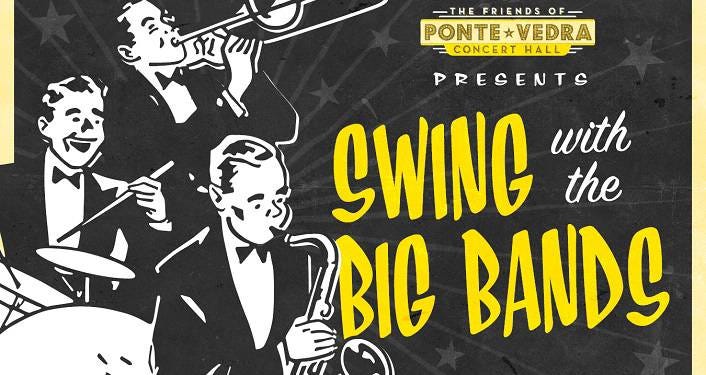
Looking for some fun on Friday nights? Tune into our ‘Swing with the Big Bands’ radio show where you’ll hear legendary live performances from the top big band artists throughout history!
Make sure to dance, bop and swing to the beat as you indulge in these incredible performances. Check Out The Schedule.
Listen to Live Jazz, Big Band & Swing Music 24 Hours a Day! The Improv Café, described as the world’s first all-live jazz station, features Singing with Swing, focusing on vocal jazz every Sunday night, Swing with the Big Bands, highlighting live big band performances, and live sets from the Village Vanguard and Blue Note.
This Week in Live Jazz — The Stories That Are Reshaping the Landscape, Right Now
There are weeks in the live music calendar when the news arrives in clusters — when a succession of announcements, releases, and events lands within days of each other and forces you to stop, take stock, and acknowledge that something larger than any single story is happening. This is one of those weeks. The jazz world delivered several seismic developments in rapid succession over the past few days, and taken together they paint a picture of an art form operating at full intensity — saying farewell to one of its most daring ensembles, welcoming back a legendary drummer from a thirteen-year hiatus, releasing one of the most anticipated vocal jazz albums in recent memory, and staging two of the most historically significant festival events of the year, on opposite sides of the Atlantic, simultaneously.
At The Improv Café — the radio station that only plays live Jazz, live Big Band, and live Swing — we track all of it. Not because it helps us curate a playlist algorithm, but because the live music ecosystem is what we broadcast, and what happens on stages and in studios and in the plans that artists and ensembles make about their futures matters to every listener who tunes in to hear real music played by real musicians in real time. This edition of the Improv Café newsletter covers the stories that broke this week, gives them the depth and context they deserve, and connects them to the larger world of live jazz that this station has always been built around. Read The Full Article on The Improv Cafe’ Substack!
The Bad Plus Announce Their Farewell: The End of One of Jazz’s Most Daring Experiments
On July 10, 2026, the avant-garde jazz community received news that had been feared and privately anticipated in equal measure for some time: The Bad Plus officially announced the full international slate of their 2026 Farewell Tour, confirming what founding bassist Reid Anderson and founding drummer Dave King had shared with heavy hearts earlier this year. After 26 years together — two and a half decades of refusing every conventional definition of what a jazz ensemble should be or do — the band will call it a career in late December.
The statement Anderson and King issued together carries the quiet dignity of musicians who have nothing to prove and everything to be proud of: “The Bad Plus has been a band for 26 years. That’s quite a long time. As we enter into year 27 — after a great deal of soul searching and consideration — we have decided to bring this chapter to a close. 2026 will be the final year of The Bad Plus. We share this news with heavy hearts, but also with great pride in what we have accomplished. It has been a privilege to share our music with the world and we leave behind a body of work that we could not be more proud of. This band changed our lives. Thank you all for being a part of that.” Read The Full Article on The Improv Cafe’ Substack!
Bill Bruford Returns: A Legendary Drummer Steps Back Into the Room
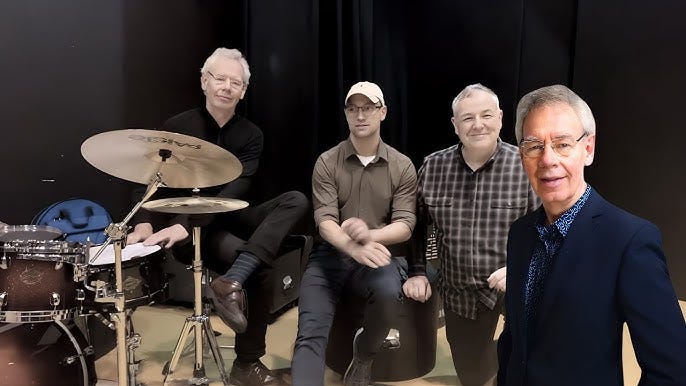
The announcement this week of the forthcoming release of Group Chat — the new live CD/DVD from the Pete Roth Trio featuring Bill Bruford — is, for a significant portion of the jazz and progressive rock worlds, the most exciting piece of music news in years. This is not hyperbole. Bill Bruford is one of the most distinguished and influential drummers in the history of either genre, a founding member of Yes, a long-term member of King Crimson, the leader of his own jazz ensemble Earthworks, and a musician who has spent five decades demonstrating that the drums are a melodic and compositional instrument of extraordinary versatility. He retired from performance in 2009. He has not appeared on newly recorded material in 19 years. Until now.
Group Chat, produced by Pete Roth and Bruford himself for Winterfold Records and set for release on September 18, 2026, documents the Pete Roth Trio — guitarist Pete Roth, bassist Mike Pratt, and Bruford on drums — in live performance, and the result is being received by advance listeners and critics as something genuinely extraordinary. The trio’s description of what they do gives you the territory: rooted in jazz but never constrained by it, moving fluidly through funk, contemporary classical influences, and spontaneous improvisation, with nothing treated as untouchable. It is a group philosophy that sounds, when you read it, exactly like the kind of music Bill Bruford has always made — music that respects the traditions it works within without being imprisoned by them, that finds the next idea rather than the comfortable one, that is live and improvised and committed to the risk of the present moment.Read The Full Article on The Improv Cafe’ Substack!
Cécile McLorin Salvant Steps Into the Orchestra — and the Result Is Stunning
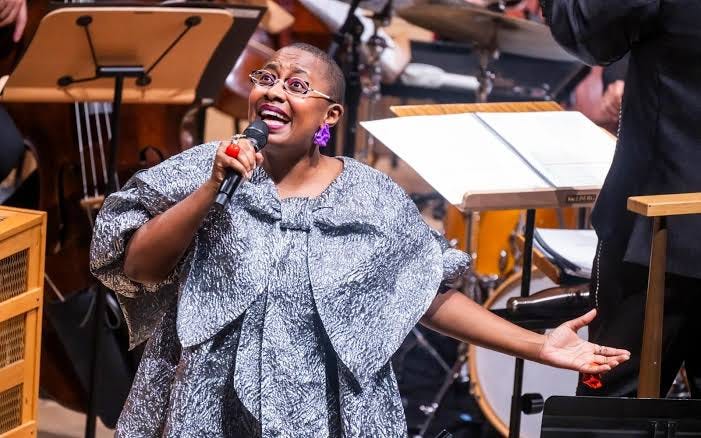
If any single release in the current jazz moment captures the full scope of what vocal jazz can be when it reaches its highest ambitions and most generous resources, it is Cécile McLorin Salvant’sWith Every Breath I Take — the Grammy-winning singer’s first full orchestral album, released June 26, 2026 on Nonesuch Records, featuring the Metropole Orkest conducted by Jules Buckley, with all arrangements conceived and executed by composer and bandleader Darcy James Argue.
The Metropole Orkest — the Netherlands’ massive symphonic orchestra dedicated entirely to pop and jazz repertoire — is not a chamber ensemble playing quietly behind a soloist. It is a full orchestra of extraordinary sonic power and flexibility, an ensemble that has built its international reputation on genre-blending collaborations with artists from Snarky Puppy to Gregory Porter to Laura Mvula, bringing a genuine jazz sensibility to orchestral scale without sacrificing either. Paired with Salvant, whose vocal intelligence and theatrical range are unlike anyone else currently working in jazz, and with Argue’s arrangements — which critics have described as “sumptuous and refined” while finding room for rolling time signatures, dancerly tempo shifts, and moody orchestral shadows — the collaboration produces something that is larger than the sum of its already extraordinary parts. Read The Full Article on The Improv Cafe’ Substack!
Montreux at 60: The Swiss Festival Returns to Its Home and the Jazz Lab Becomes an American Club
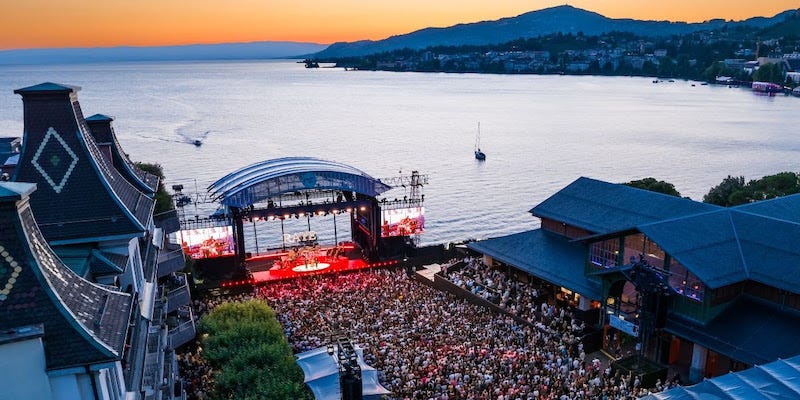
While the jazz news at home has been dominated by farewells and returns and new releases, the global calendar is currently anchored by one of the most historically resonant events in the international festival landscape: The Montreux Jazz Festival, currently running through July 18, 2026, in its 60th anniversary edition — and doing so, for the first time since 2023, from within the fully renovated halls of its legendary home venue.
The Montreux Music & Convention Centre — completely rebuilt over three years at a cost of 94 million Swiss francs and rechristened as the 2M2C — reopened its doors for this 60th edition with updated acoustics, redesigned access, and new panoramic terraces overlooking Lake Geneva and the Alps, and it brings back the two rooms that define what Montreux sounds like at its most essential: the Auditorium Stravinski, with a capacity of 4,000, and the Montreux Jazz Lab, the club-scale intimate room where late-night performance has always been the most electric and unpredictable programming the festival offers. Read The Full Article on The Improv Cafe’ Substack!
PERUJAZZ Live in Madrid: Afro-Peruvian Jazz Crosses the Atlantic
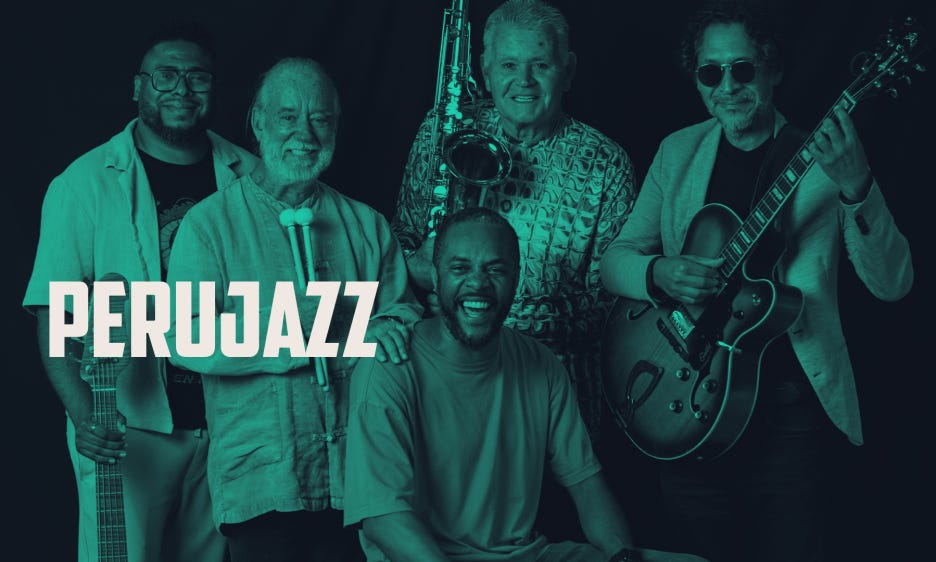
One of the more quietly significant broadcasts of the current week happened on July 11, when the global streaming platform Oh! Jazz aired a live presentation of PERUJAZZ from Café Berlín in Madrid — a performance that placed the ensemble’s distinctive fusion of Afro-Peruvian rhythms, Andean musical traditions, and modern jazz improvisation before an international streaming audience that extended far beyond the Spanish capital.
PERUJAZZ occupies a genuinely rare position in the global jazz landscape — a group that takes one of South America’s richest and most rhythmically complex musical traditions and places it in direct, unmediated contact with the jazz language rather than simply deploying it as exotic color. Afro-Peruvian music has its own percussive vocabulary, its own rhythmic feel, and its own emotional character, shaped by centuries of African, Indigenous, and European influence converging in the coastal cities and highland communities of Peru. PERUJAZZ brings all of that into the jazz conversation with authenticity and creative intelligence, producing music that neither genre fully anticipated and that both are richer for having encountered. Read The Full Article on The Improv Cafe’ Substack!
Tony Adamo and the Spoken Word Jazz Tradition
In the category of music that exists at the fascinating intersection of multiple forms — where jazz improvisation meets the spoken word, where the groove becomes a vehicle for language rather than a backdrop for instrumental display — Tony Adamo’s new single It’s Gotta B U!, released July 7, 2026, represents the vanguard of a tradition with deep jazz roots. The organ-driven funk single serves as the opening statement for Adamo’s upcoming album Sing Speak Hipspoken Word, and it is precisely what its title promises: energetic, groove-forward, and committed to a vision of the jazz-spoken word synthesis that hip-hop first encountered in the jazz vocal tradition and that Adamo has spent his career developing in his own distinctive direction. Read The Full Article on The Improv Cafe’ Substack!
Coming Thursday: Harry Forlenza-Bailey Ensemble at Bourbon & Branch, Philadelphia
For listeners in the Philadelphia area — and for anyone who believes that live jazz in an intimate neighborhood setting is one of the essential pleasures that a great city can offer — this Thursday, July 16, provides a genuinely wonderful opportunity. The Harry Forlenza-Bailey Ensemble headlines a free evening of live jazz at Bourbon & Branch in Philadelphia, beginning at 9:00 PM. Read The Full Article on The Improv Cafe’ Substack!
Back Deck 2026 Tonight: AMANI: The Music of Burt Bacharach
Spend a summer evening under the stars celebrating the unforgettable music of one of America’s greatest songwriters. Amani brings its polished vocal harmonies, refined musicianship, and expressive interpretations to the timeless compositions of Burt Bacharach, creating a concert that honors both the elegance and emotional depth of his remarkable catalog.
Audiences can expect beautifully crafted performances of beloved favorites including Walk On By, Alfie, What the World Needs Now Is Love, and other enduring classics. With fresh arrangements and heartfelt performances, Amani captures the sophistication and warmth that have made Bacharach’s music resonate across generations.
Set against the relaxed atmosphere of the Back Deck, this outdoor concert offers the perfect setting to enjoy an evening of exceptional live music. Whether you’re a longtime admirer of Burt Bacharach’s songwriting or discovering these iconic songs for the first time, this performance promises an unforgettable experience filled with timeless melodies and unforgettable moments. Read The Full Article on The Improv Cafe’ Substack!
The Week in Perspective: What All of This Means
Step back for a moment and consider what this week’s news, taken together, actually shows you. The Bad Plus — one of the most daring and original jazz ensembles in modern history — is saying goodbye with a farewell tour that spans five continents and ends, fittingly, at home. Bill Bruford — a musician who walked away from performance thirteen years ago and has been missed every moment since — is returning with a live recording of such quality that critics are already reaching for superlatives. Cécile McLorin Salvant — arguably the greatest jazz vocalist currently working — has released her first orchestral album, and it is everything her reputation promised and more. Montreux Jazz Festival is celebrating its 60th anniversary inside a newly renovated home venue, with Marcus Miller honoring Miles Davis’s centennial in a Jazz Lab transformed into an American club and Charles Lloyd returning to a stage he first graced 59 years ago. PERUJAZZ is bringing Afro-Peruvian jazz to Madrid and the world. Tony Adamo is pushing at the boundaries of what spoken word and jazz can be together. And on Thursday, free live jazz is happening in Philadelphia, because that is what live jazz does: it shows up in every room that will have it, at every scale, for every kind of audience that is willing to listen. Read The Full Article on The Improv Cafe’ Substack!
The Improv Café — Live Jazz. Live Big Band. Live Swing. All live. Every song. Every night. No exceptions
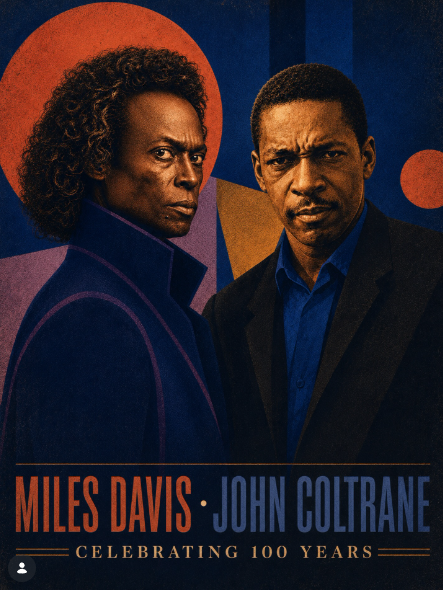
Two Men Born in 1926 Changed Everything. A Century Later, the World Is Listening Again — and The Improv Café Is Broadcasting Every Moment of It.
There are birthdays, and then there are birthdays. There are anniversaries that appear on a calendar and pass like any other date, and then there are the ones that stop the music industry in its tracks, open the archives, fill concert halls, ignite museum exhibitions, send musicians on tour around the globe, and cause every jazz festival with any claim to cultural seriousness to restructure its programming in recognition of something larger than any single event. The year 2026 is the second kind. Not because of one birthday, but because of two — falling just months apart — belonging to two musicians who, more than any others who ever picked up their instruments and stood in front of a microphone, reshaped what music itself could mean. Read The Improv Cafe’ Substack for Live Jazz News!
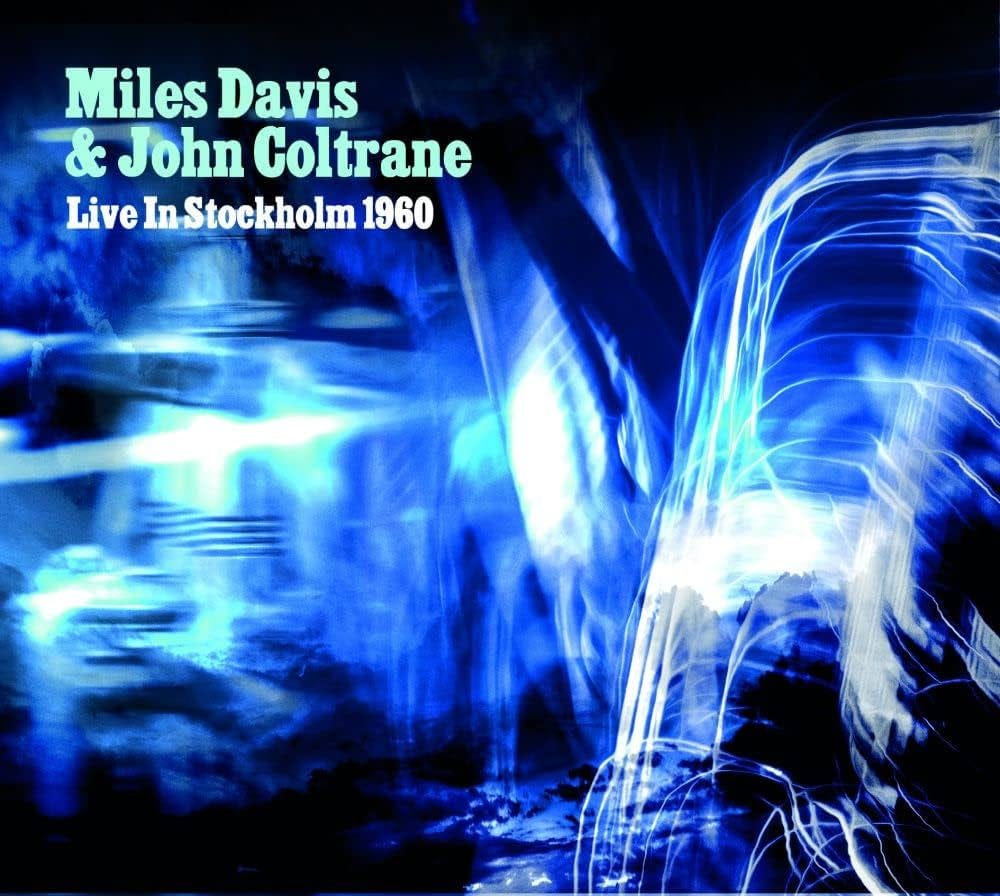
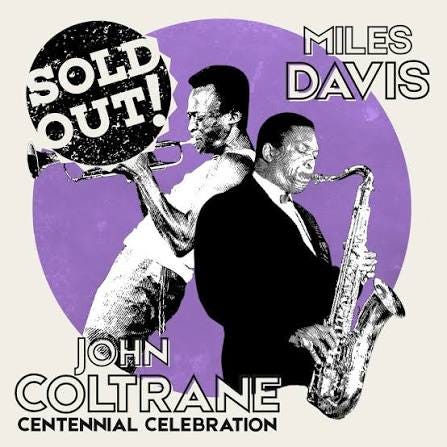
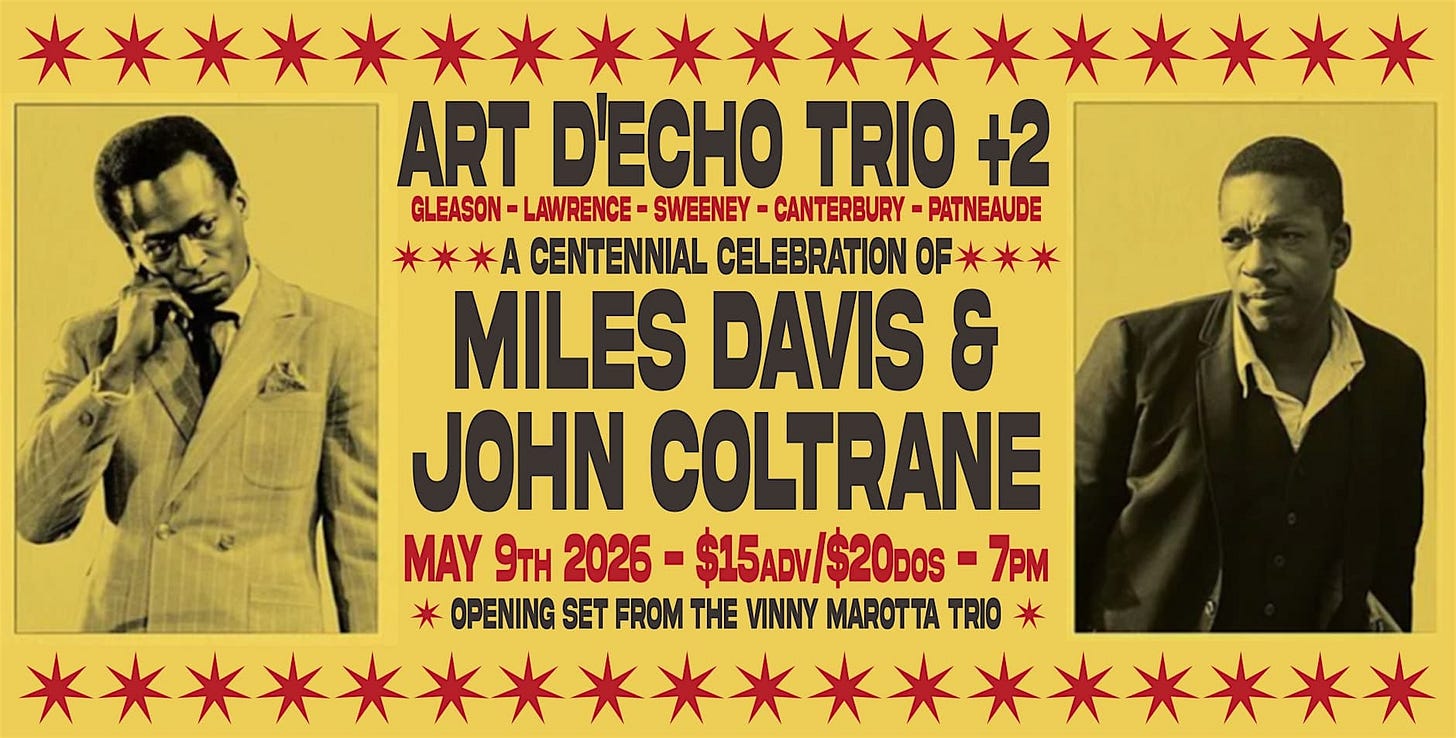
Miles Dewey Davis III was born on May 26, 1926, in Alton, Illinois. John William Coltrane was born on September 23, 1926, in Hamlet, North Carolina. One a trumpet player, cool and searching, perpetually reinventing himself with a restlessness that made him simultaneously the most influential figure in jazz history and the most difficult to contain within any single style or category. The other a tenor saxophonist of almost terrifying spiritual intensity, a man who approached the saxophone as a vehicle for the exploration of something beyond music, beyond art, beyond the ordinary boundaries of human expression. Together, before they went their separate and equally extraordinary ways, they recorded some of the most important music in the history of the 20th century. Apart, they each produced bodies of work that are still being studied, performed, analyzed, debated, and loved by musicians and listeners around the world, six decades after their most transformative records were made. Read The Improv Cafe’ Substack for Live Jazz News!
Born Months Apart, Joined at the Musical Hip — The Story of Two Architects
To understand why the centennial of Miles Davis and John Coltrane matters so profoundly — not just to jazz, not just to the music community, but to anyone who has ever been moved by American popular culture in any form — you have to understand what these two men were to each other and what they were, separately, to the art form they inhabited and transformed.
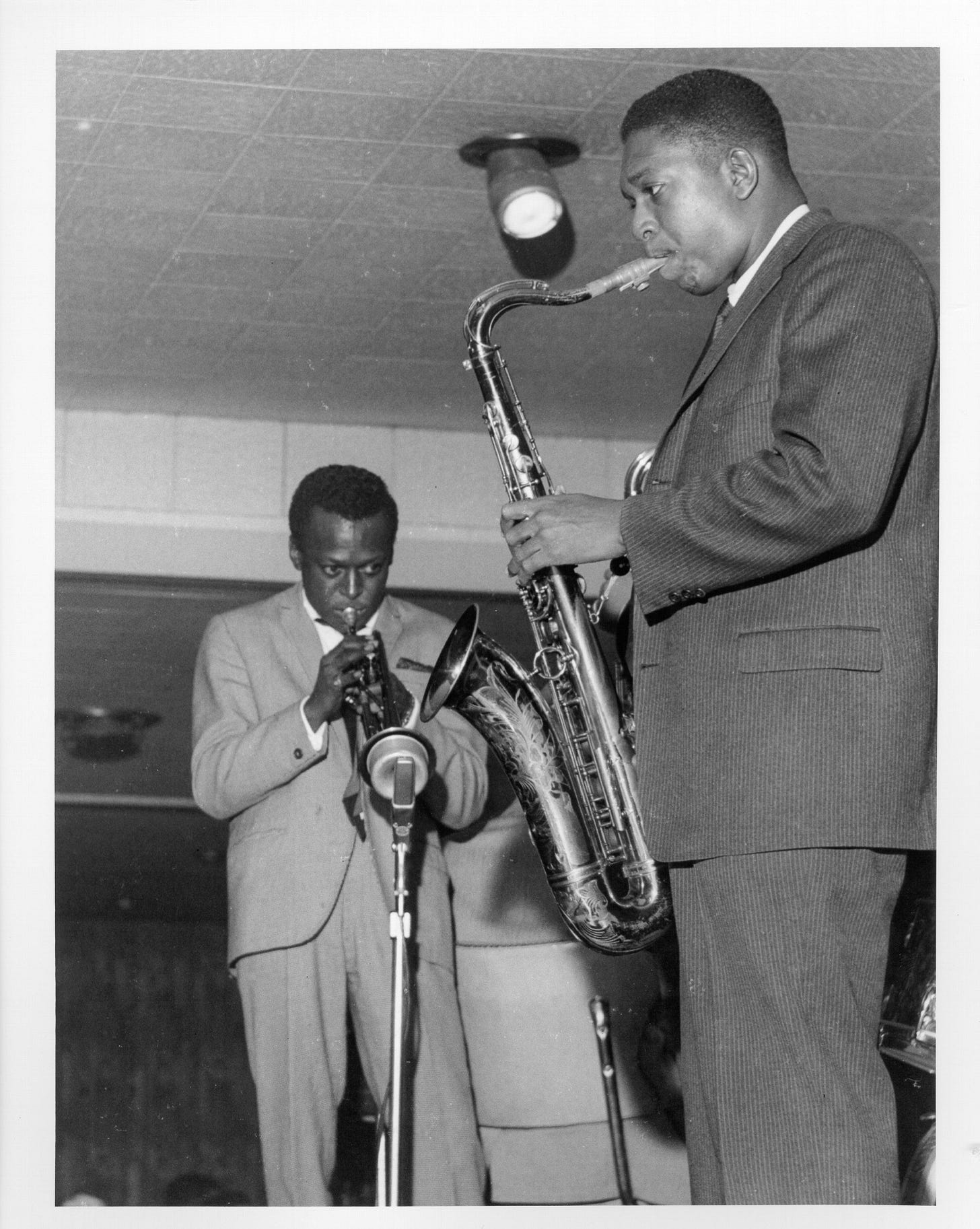
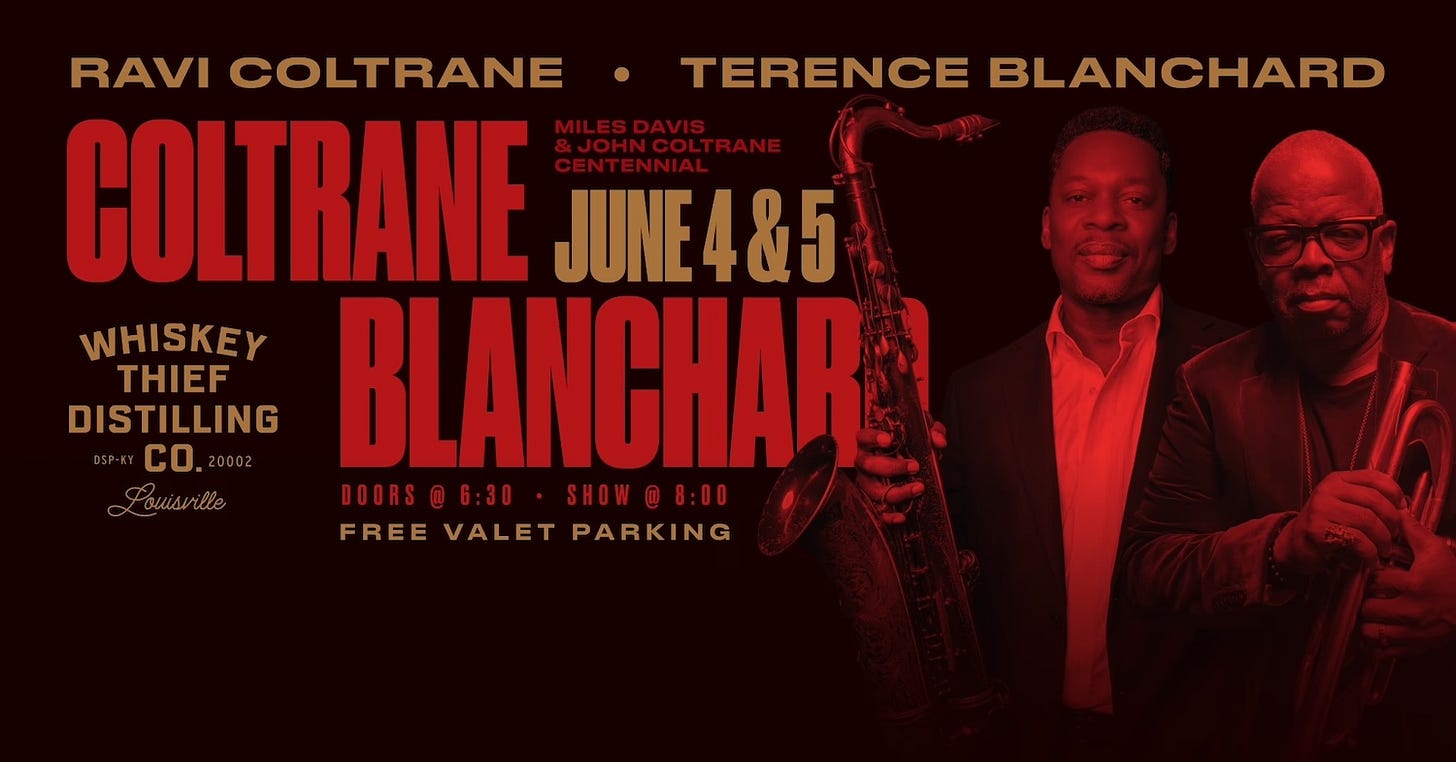
Their professional lives intersected at one of the most fertile and consequential moments in jazz history: the mid-1950s, when Davis assembled his First Great Quintet and placed Coltrane on tenor saxophone alongside him. Between 1955 and 1957, and again from 1958 into 1959, those two musical presences shared a bandstand, shared a studio, shared the creative challenge of figuring out what jazz could be next. The chemistry between Miles’s cool, recessive trumpet — which communicated more in the space between notes than most musicians could say with a full solo — and Coltrane’s surging, searching tenor, which pushed the harmonic boundaries of every tune it touched — was unlike anything the music world had previously produced. It was the sound of two enormous artistic minds working alongside each other at the peak of their early powers, each one pushing the other toward territory neither would have found alone. Read The Improv Cafe’ Substack for Live Jazz News!
John Coltrane: The Search That Never Stopped
If Miles Davis was the architect of jazz’s cool — the musician who taught restraint and space as musical virtues — then John Coltrane was the force of nature who took everything Miles and the modal revolution had suggested and pushed it to its absolute limit, and then kept pushing beyond that. Coltrane did not stop at modal jazz. After Kind of Blue, he formed his own quartet and assembled one of the most extraordinary ensembles in the history of improvised music: pianist McCoy Tyner, bassist Jimmy Garrison, and drummer Elvin Jones, three musicians who were themselves innovators of the highest order, whose collective vocabulary reshaped their respective instruments in ways still felt today. Read The Improv Cafe’ Substack for Live Jazz News!
The Impact That Will Not Be Contained: How Davis and Coltrane Changed Everything Beyond Jazz
One of the things that makes the centennial of Miles Davis and John Coltrane more than a jazz industry event — that makes it a genuine cultural milestone — is the scope of their influence outside the genre they inhabited. These were not musicians who stayed in their lane. They could not have stayed in their lane if they had tried, because their musical thinking was too radical, too restless, and too generative to remain contained by genre boundaries.
Miles Davis reinvented himself more completely and more frequently than any musician of his generation. He moved from bebop to cool jazz to hard bop to modal jazz to electric jazz-fusion, and at every transition he dragged music history with him. His 1970 album Bitches Brew essentially invented jazz-rock fusion as a commercial and artistic form, influencing the development of rock, funk, and electronic music in ways that continue to reverberate. The musicians who played in his bands during the late 1960s and 1970s — Herbie Hancock, Wayne Shorter, Chick Corea, John McLaughlin, Tony Williams, Jack DeJohnette — went on to become founders of entire movements in music. What Miles taught them, consciously or not, was that the musician’s job was not to master a style but to find the next one. Read The Improv Cafe’ Substack for Live Jazz News!
The World Responds: A Global Wave of Centennial Celebration
Because both men would have turned one hundred in 2026, the jazz world — and the broader music world — is responding with a scale and intensity of programming that has no modern precedent for a jazz anniversary. Every jazz festival in the world with any claim to cultural seriousness has incorporated centennial programming. College jazz programs are restructuring curricula. Record labels are mining archives. Venues are scheduling year-long residencies. And the performers carrying the tribute torch forward are some of the finest musicians currently working, bringing genuine creative investment rather than rote ceremonial recreation to the music of two men who would have despised nothing more than rote ceremonial recreation. Read The Improv Cafe’ Substack for Live Jazz News!
Newport Jazz Festival 2026: The Centennial Comes to Fort Adams
Among the concert events of the centennial year, few carry the historical resonance of what is scheduled for the Newport Jazz Festival — a festival that has its own deep connection to the legacies of both Davis and Coltrane, having hosted landmark performances by both men during their careers. The 72nd annual Newport Jazz Festival runs July 31 through August 2, 2026, at Fort Adams State Park in Newport, Rhode Island, and at its center sits a centennial tribute performance of extraordinary weight and promise. Read The Improv Cafe’ Substack for Live Jazz News!
The Vaults Open: Archival Releases and the Year of the Lost Recording
One of the most distinctive dimensions of any great musical centennial is what the record labels and estates decide to release from the archives — and 2026 has already proven to be one of the richest years in recent memory for archival jazz releases, with Davis and Coltrane at the center of the story.
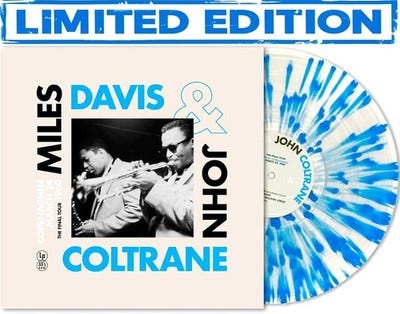
Craft Recordings’ centennial reissue of Davis’s The New Sounds — his first release as a bandleader, originally pressed on Prestige in 1951 — brought one of the earliest documents of his leadership back into print in the original 10-inch format, restoring the physical object to something close to what listeners in 1951 would have held in their hands. The session’s extraordinary personnel — Jackie McLean on alto saxophone, Sonny Rollins on tenor saxophone, Art Blakey on drums — makes it a document of jazz royalty assembled at a moment when none of them had yet become the legends they would be. Read The Improv Cafe’ Substack for Live Jazz News!
Education, Research, and the Music That Teaches
The centennial is reshaping jazz education as powerfully as it is reshaping the concert calendar. At music schools and conservatories across the country and around the world, 2026 has brought with it a wave of new curricula, workshops, lectures, and performance projects organized around the music of Davis and Coltrane and its legacy — not just within jazz but across the full range of genres that absorbed and responded to what these two men created. Read The Improv Cafe’ Substack for Live Jazz News!
What The Improv Café Brings to the Centennial
We play every live recording and every live release by both of these artists. There is only one way to truly encounter the music of Miles Davis and John Coltrane — the same way there is only one way to encounter any music that was made live, by musicians in the room, in the presence of an audience. You have to hear the live version. Not because studio recordings are inadequate — Kind of Blue itself is a studio recording, and it is one of the supreme achievements of recorded music — but because the live recordings of Davis and Coltrane carry something that studio recordings cannot fully replicate: the evidence of what happened when they played in front of people. Read The Improv Cafe’ Substack for Live Jazz News!
The Centennial That Belongs to Everyone
Perhaps the most striking thing about the global response to the 100th birthdays of Miles Davis and John Coltrane is how genuinely broad that response is. This is not a jazz-world-only event. The centennial is being marked by symphony orchestras and hip-hop festivals, by museum curators and rock radio stations, by academic conferences and outdoor summer concerts in parks. The music of two men who spent their lives resisting categorization turns out to belong to every category — or to none of them, which amounts to the same thing.
For listeners of The Improv Café — for everyone who has tuned in because they understand that the live version is the real version, that the spontaneous moment is the essential moment, that music heard through the filter of a stage and an audience carries something that music heard in a studio never quite can — this centennial is a homecoming. The music of Miles Davis and John Coltrane was always live at its core. It was always built on the premise that the most important thing happening in the room was what the musicians were inventing together in real time. That is the premise of every great jazz performance, and it is the premise of The Improv Café. Read The Improv Cafe’ Substack for Live Jazz News!
2026: The Year the World Listened Again
The centennial of Miles Davis and John Coltrane is not a memorial. It is not a backward glance at what was. It is an active, ongoing, globally distributed engagement with two of the most original musical minds of the 20th century, conducted by musicians who find in their work not a finished object to be preserved but a living set of questions to be pursued. Newport Jazz Festival, Smoke Jazz Club, the Montreal Jazz Festival, concert halls in Paris and Ann Arbor and Boulder and Kansas City and every point between — all of them are asking the same questions that Davis and Coltrane spent their careers asking. What comes next? What has not been played yet? Where does the music go when it reaches the edge of what it knows? Read The Improv Cafe’ Substack for Live Jazz News!
SMOKE Jazz Club (NYC): New York City’s premier venue announced a major August lineup dedicated to these centennials. Grammy-winner Nicholas Payton will lead a marquee tribute performing Davis’s Kind of Blue and Coltrane’s A Love Supreme. New Album Announcements: Renowned jazz vocalist Lizz Wright and pianist Kenny Banks Sr. just announced their upcoming intimate duo LP, Nearness, slated for a September release. Regional Series: The Queens Jazz Trail Concert Series launched outdoor performances across New York City parks to honor historic neighborhood jazz icons.
The Miles & Coltrane Collaborative Playlist: These five essential tracks trace their time together in Miles’s “First Great Quintet” and the legendary 1959 sextet sessions. They show how Miles’s spacious, cool trumpet perfectly balanced Coltrane’s high-energy, rapid-fire saxophone style.
“So What” (Kind of Blue, 1959) The ultimate introduction. It features Miles’s most famous, relaxed trumpet solo, followed immediately by a powerful, legendary solo by Coltrane.
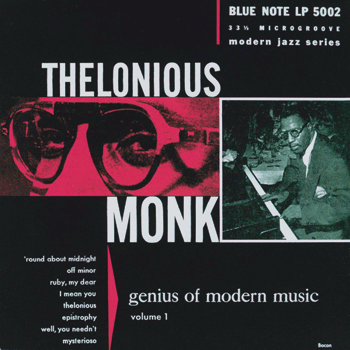
“‘Round Midnight” (‘Round About Midnight, 1957) A beautiful, moody performance of Thelonious Monk’s classic ballad. This track put the jazz world on notice that this duo was something special.
“All Blues” (Kind of Blue, 1959) A dreamy, late-night blues track in a rolling 6/8 time signature. It highlights their incredible chemistry and contrasting solo styles.
“If I Were a Bell” (Relaxin’ with the Miles Davis Quintet, 1958) A bright, joyful, and up-tempo show tune. It opens with Miles playfully ringing a dinner bell and features a incredibly fluid, swinging solo by Coltrane.
“Blue in Green” (Kind of Blue, 1959) A deeply melancholic, poetic ballad. The song moves like a slow-motion watercolor painting, showcasing their unmatched emotional depth.
Local Jazz News: Philadelphia & Cherry Hill Area
If you are looking to catch a live show near Cherry Hill and Philadelphia, local jazz hubs have an incredibly active lineup of concerts and album release parties over the next two weeks:
Meron Menares Macbride Album Release Show
Date & Time: Tuesday, July 14, 2026 at 7:30 PM
Venue: Chris’ Jazz Cafe, 1421 Sansom St, Philadelphia, PA
Description: Pianist Daniel Meron, bassist Pablo Menares, and drummer Jimmy Macbride perform a night of modern jazz blending Middle Eastern and Latin American rhythms to celebrate their new live album.
Cost: Ticket prices vary by package (General Admission a la carte to VIP Dinner options).
Ragan Whiteside Live
Date & Time: Thursday, July 9, 2026 at 9:00 PM
Venue: Gerald Veasley’s Unscripted Jazz Series at SOUTH Restaurant & Jazz Parlor, 600 N Broad St, Philadelphia, PA
Description: A high-energy, soulful performance by the chart-topping contemporary jazz flutist and NAACP Image Award nominee.
Cost: Admission ticket required.
Saxophonist Robert Boyd Jr. & His Quartet
Date & Time: Friday, July 10, 2026 at 9:30 PM
Venue: Chris’ Jazz Cafe, 1421 Sansom St, Philadelphia, PA
Description: Straight-ahead, hard-hitting quartet jazz led by Robert Boyd Jr.
Cost: $25 General Admission; Dinner packages available from $100–$120.
Frank Sinatra & Judy Garland Tribute
Date & Time: Saturday, July 11, 2026 at 7:30 PM & 9:30 PM
Venue: Chris’ Jazz Cafe, 1421 Sansom St, Philadelphia, PA
Description: A vocal jazz tribute tracking the American Songbook classics, featuring Bruce Klauber and Mary Ellen Desmond.
Cost: $30 General Admission; Dinner packages available.
Behn Gillece & Brian Betz Duo
Date & Time: Wednesday, July 8, 2026 at 5:30 PM
Venue: Time Bar, 1315 Sansom St, Philadelphia, PA
Description: A brilliant local happy-hour set featuring virtuosic vibraphonist Behn Gillece alongside guitarist Brian Betz.
There are seasons in music that announce themselves with unusual clarity — when the convergence of events, residencies, festivals, and live performances makes it undeniable that something important is happening, right now, in real time, across the full spectrum of what jazz, swing, and live music can be. Summer 2026 is one of those seasons. From the largest jazz festival on the planet, still in full swing through the first days of July, to an Adriatic coast celebration blending New York jazz royalty with European artistic energy, to the intimate magic of Manhattan’s finest vocal jazz residencies, to world-class performances landing right here in the Philadelphia and South Jersey region — the global live jazz circuit is currently operating at its absolute summer peak, and The Improv Café is here to document it all, celebrate every stage of it, and give it the soundtrack it deserves.
Tonight, The Improv Café continues its unwavering broadcast commitment: every song played on this station is the live version. Live Jazz. Live Big Band. Live Swing. Live Vocal Jazz. No studio recordings, no digital approximations, no curated algorithmic approximations of the real thing. What you hear on The Improv Café came from a stage, a club, a festival, a ballroom — it happened in real time, in a room, with musicians and audience breathing the same air and making something together that could not have happened any other way. That is the format. That is the promise. That is why this station exists, and why tonight it celebrates a live jazz world that is producing some of the most extraordinary music and performance happening anywhere on earth. Read the Full Live Jazz Article on The Improv Cafe’ Substack!
The Largest Jazz Festival on Earth Is Happening Right Now
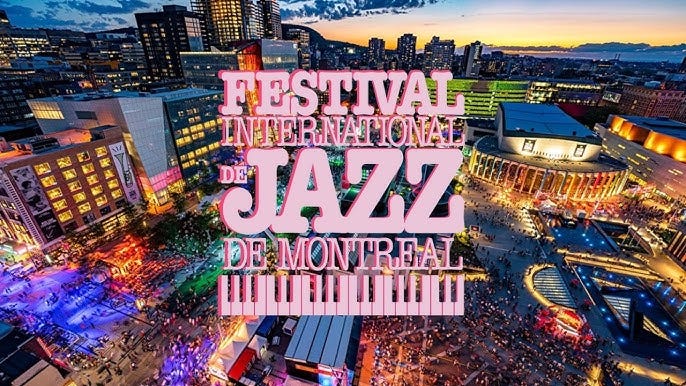
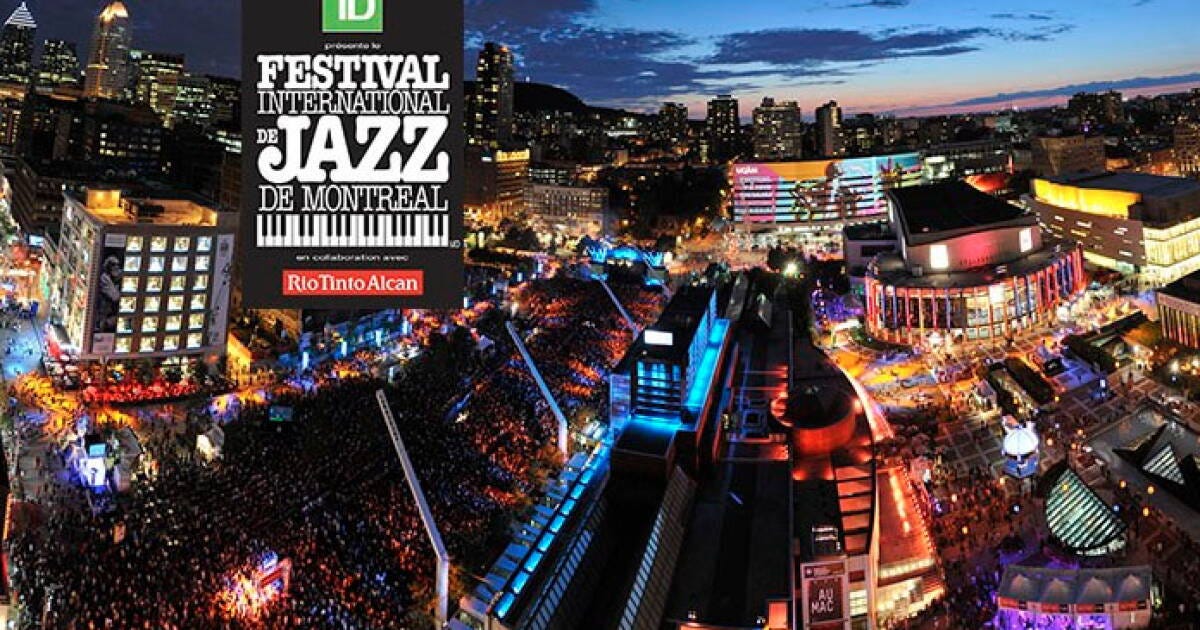
If there is a single event that captures the scale of what live jazz has become as a global cultural force, it is the Festival International de Jazz de Montréal — recognized by Guinness World Records as the largest jazz festival on the planet. The 46th edition is running through July 4, 2026, in the Quartier des Spectacles in the heart of downtown Montreal, and the numbers alone are extraordinary: more than 350 concerts over ten days, featuring 3,000 performers drawing over two million attendees, with two-thirds of all programming available completely free of charge to anyone who shows up. The streets close to traffic, the stages come alive at every scale from intimate indoor rooms to massive outdoor gathering spaces, and the city transforms into a living, breathing, ten-day celebration of what music — jazz at its center, boundless in its reach — can do when given a proper stage. Read the Full Live Jazz Article on The Improv Cafe’ Substack!
The Made in New York Jazz Festival Brings the Sound of New York to the Adriatic
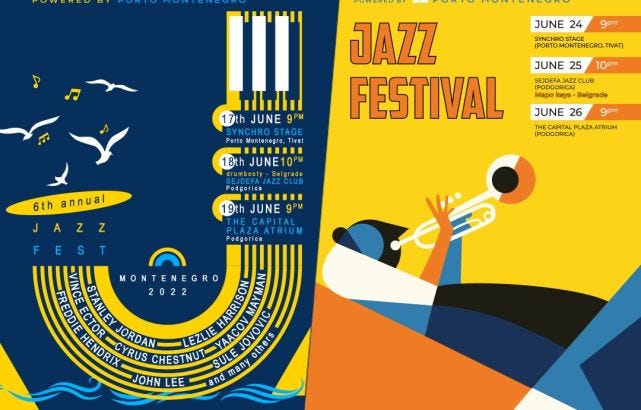
While Montreal holds the largest gathering, one of the most distinctive jazz events of the international summer has been unfolding along the stunning Adriatic coastline of Montenegro. The Made in New York Jazz Festival, now in its 11th edition, completed its landmark run from June 26 through 28, 2026, spread across three cities on the Montenegrin coast and interior — Tivat, Cetinje, and Podgorica — in what the organizers marked as their most significant edition yet, offering completely free admission to all events to coincide with Montenegro’s 20th year of independence.
This festival occupies a unique position in the global jazz world. It was built from the beginning on a specific and compelling premise: take the improvisational energy, the artistic adventurousness, and the individual virtuosity that defines the New York jazz scene — which remains, by most accounts, the most generative jazz community on earth — and bring it to a landscape and an audience that experience it against a completely different cultural backdrop. The results, across eleven editions, have consistently proven that jazz transcends geography in ways that go beyond the obvious. The music does not need translation. It communicates directly, and it communicates powerfully, whether you are hearing it in a downtown Manhattan club at midnight or on a summer stage in Porto Montenegro with the Adriatic reflecting the light behind the bandstand. Read the Full Live Jazz Article on The Improv Cafe’ Substack!
Smoke Jazz Club, Manhattan — The Greatest Vocal Jazz Month in Recent Memory
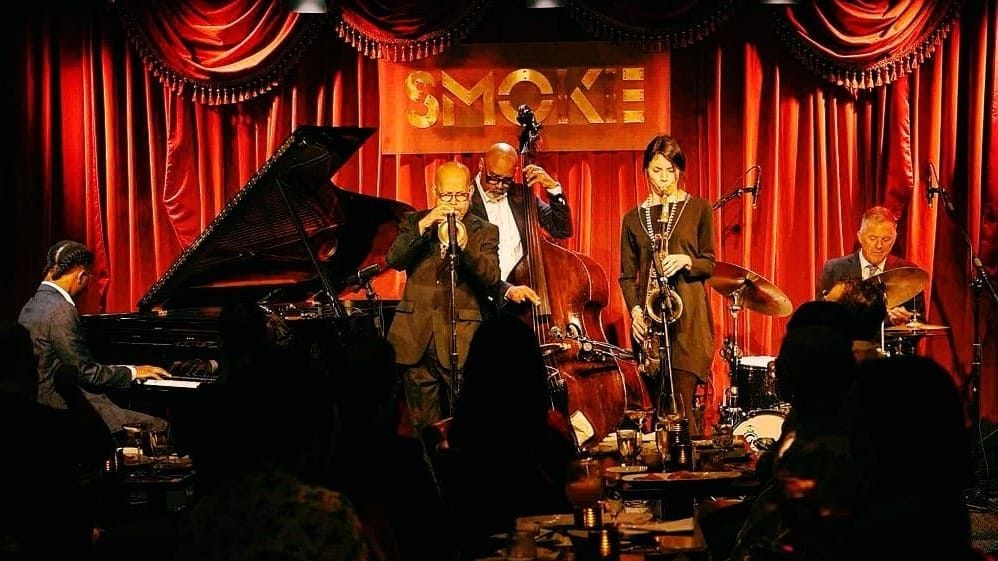
If the festivals represent jazz at its widest and most expansive, the club residency represents the music at its most concentrated and most intimate — and right now, on the Upper West Side of Manhattan, Smoke Jazz Club is delivering what may be the finest month of vocal jazz programming any room in New York has offered in recent years. Hailed as the number one jazz club in New York City, Smoke has built its July 2026 lineup around a triumvirate of vocalists who represent the absolute summit of what jazz singing means in the modern era.
The month opened with Tierney Sutton, a nine-time Grammy-nominated vocalist whose ability to inhabit a standard is singular — she does not interpret songs so much as she reveals them, finding dimensions of meaning and feeling that feel both completely fresh and completely inevitable. Her residency at Smoke brought together an exceptional supporting cast: multi-Grammy-winning trumpeter Randy Brecker for the opening nights, followed by the legendary tenor saxophonist Houston Person, with Lewis Nash on drums, Tamir Hendelman on piano, and Ricky Rodriguez on bass. The combination of Sutton’s voice with Brecker’s trumpet — warm, technically sovereign, and emotionally direct — and then with Person’s signature warmth and depth represents exactly the kind of live jazz experience that cannot be approximated on record. It has to be heard in a room. Or broadcast, as it happened, by a station devoted to nothing else. Read the Full Live Jazz Article on The Improv Cafe’ Substack!
The Solar Myth and Philadelphia’s Avant-Garde Moment
Not every live jazz experience announces itself with a famous name or a celebrated residency. Some of the most important performances in the current scene happen in smaller rooms, outside the conventional circuit, among musicians who are pushing the music in directions that established venues might not always reach. The Solar Myth in Philadelphia’s Passyunk Square neighborhood has been one of the most closely watched spots in the regional jazz world, a venue where the avant-garde and experimental branches of the music find a consistent home — and where a recent performance by the DoYeon Kim Quartet drew the kind of attention from serious listeners and critics that signals something genuinely worth noting. Read the Full Live Jazz Article on The Improv Cafe’ Substack!
Tonight in Philadelphia: Big Band Jazz at Pastorius Park
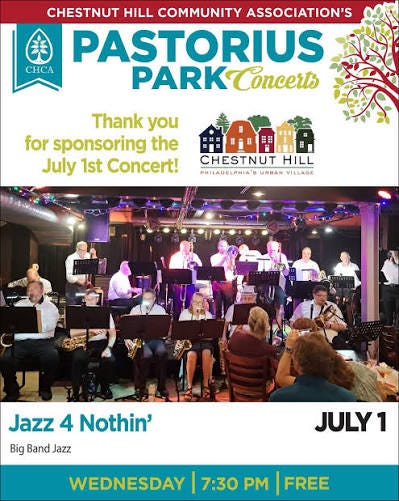
For listeners in the Greater Philadelphia area who want to experience live jazz not through a speaker but in the open air, tonight offers something immediate and wonderful. The ensemble Jazz 4 Nothin’ takes the stage at Pastorius Park in Philadelphia at 7:30 PM tonight, July 1, 2026, for an evening of live Big Band jazz in one of the city’s most beloved outdoor venues. This is the kind of event that The Improv Café was built to celebrate — live big band music, outdoors, accessible, in the community, happening right now. It does not require a ticket reservation or a covered charge. It requires showing up, finding a good spot, and letting the full sound of a live big band do what it does — fill the air, set the evening in motion, and remind everyone in earshot why this music has always been a public art form as much as a concert hall one. Read the Full Live Jazz Article on The Improv Cafe’ Substack!
Coming Up in the Region: A Summer of Live Jazz Close to Home
The weeks ahead bring extraordinary live jazz even closer to home for listeners in the South Jersey and Greater Philadelphia area, and The Improv Café wants you to know about every one of them.
Walter Beasley, one of the most accomplished and beloved saxophonists in the smooth jazz world, comes to Wilson’s Restaurant & Live Music in Hi-Nella, New Jersey on August 8, 2026, for an intimate evening of live performance. Beasley’s career spans four decades and more than thirty albums, including chart-topping Billboard successes and recordings that have defined the smooth jazz format for a generation of listeners. He spent 35 years on the faculty at Berklee College of Music, shaping musicians who are now themselves performing on stages around the world, and his live performances carry all of that depth and craft into something warm, accessible, and genuinely moving. Wilson’s is a venue that takes its commitment to the live music experience seriously, described by its founders as a first-class jazz restaurant and entertainment venue designed for South Jersey — and an evening with Beasley in that room represents exactly the kind of intimate, high-quality live experience that reminds you why nothing replaces being in the room with great music. Read the Full Live Jazz Article on The Improv Cafe’ Substack!
The Philadelphia Clef Club: Where the Legacy Is Being Written Forward
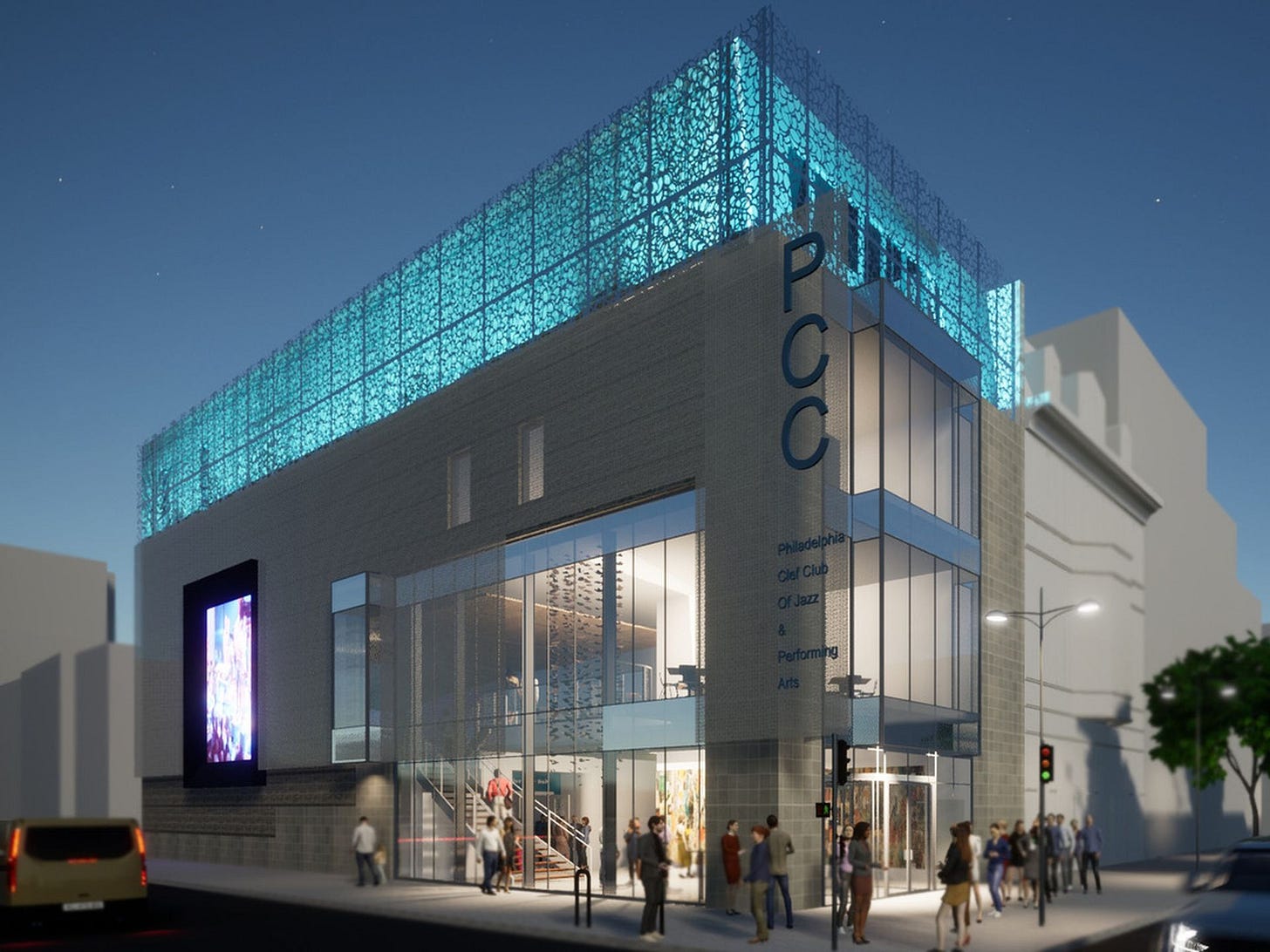
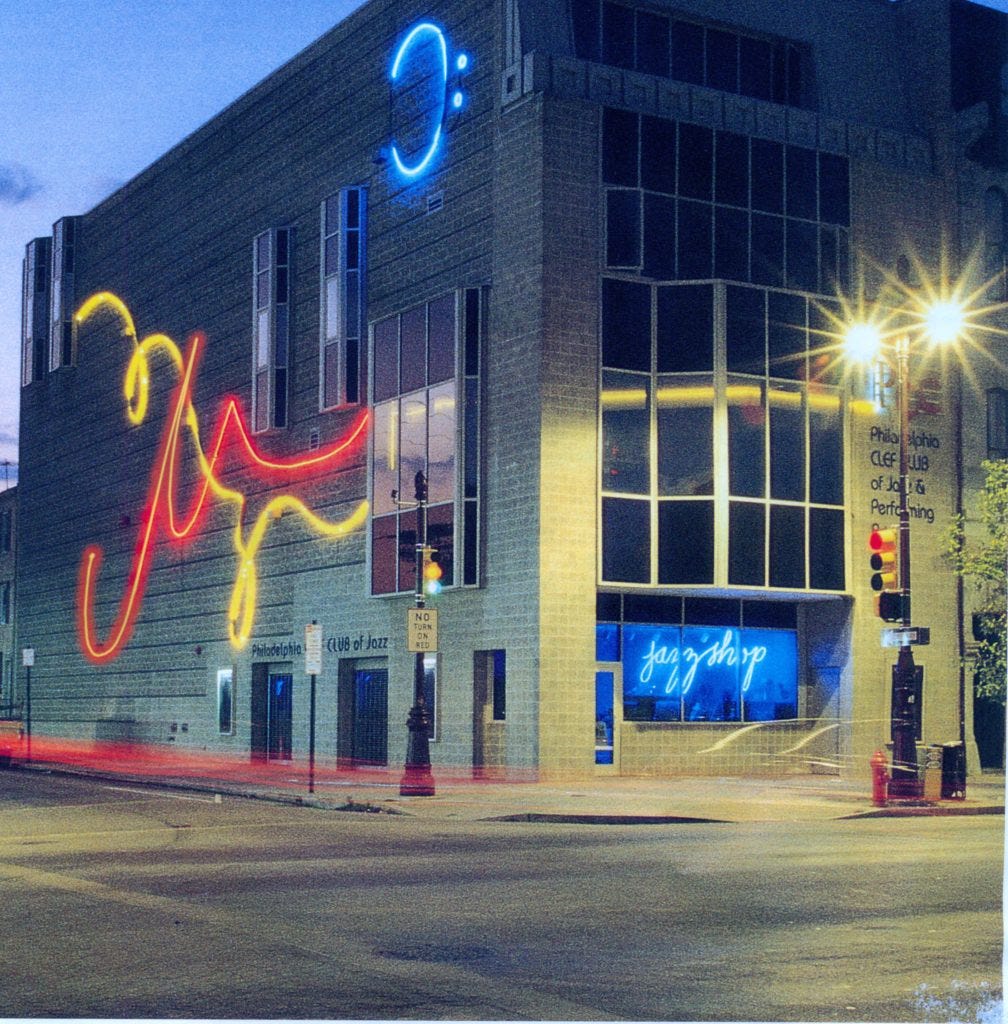
No conversation about live jazz in the Greater Philadelphia region is complete without acknowledging the extraordinary institution that sits at the center of it — the Philadelphia Clef Club of Jazz and Performing Arts, located at 736 South Broad Street in the heart of the city, the first facility ever designed and constructed specifically as a jazz institution. This is not just a venue. It is a monument to the place jazz has always held in Philadelphia’s cultural life and a living center for its ongoing development.
The Clef Club was founded in 1966 by members of an African American musicians union whose membership rolls included John Coltrane, Dizzy Gillespie, Lee Morgan, Philly Joe Jones, Shirley Scott, Grover Washington Jr., the Heath Brothers, and Nina Simone — a roster that reads like the history of jazz itself, anchored in one city’s extraordinary creative community. Now celebrating its 60th anniversary in 2026, the institution has expanded its mission, its facility, and its programming without ever losing sight of what it was built to do: celebrate and preserve the legacy of jazz while supporting the living artists who carry it forward. Read the Full Live Jazz Article on The Improv Cafe’ Substack!
What All of This Proves — And What The Improv Café Has Always Known
Survey the landscape of what is happening in live jazz right now — the 46th Montreal Jazz Festival filling a city with two million attendees; the Made in New York Jazz Festival bringing John Scofield to the Adriatic coast; Tierney Sutton, Jane Monheit, and René Marie at Smoke for an extraordinary month of vocal jazz in Manhattan; the DoYeon Kim Quartet pushing boundaries at Solar Myth in Philly; Jazz 4 Nothin’ bringing big band joy to Pastorius Park tonight; Walter Beasley coming to Wilson’s in South Jersey; Richard Hill Jr. and the Music Legends Matinee at the Clef Club — and what you see is not a scene in decline, not a niche market sustaining itself against the odds, but a thriving, diverse, globally distributed community of musicians and listeners who have found each other around something irreplaceable. Read the Full Live Jazz Article on The Improv Cafe’ Substack!
A Stage, a Room, a Sound That Cannot Be Faked — The Blue Note Story and the Live Music Promise That Defines The Improv Café
There is a reason that certain rooms become legendary. It is not the architecture, though that matters. It is not the lighting or the décor, though those set the stage. It is not even the address, though in the case of the world’s greatest jazz clubs, location has always carried weight. What makes a room legendary is something that cannot be built into the walls during construction, cannot be engineered by an interior designer, and cannot be manufactured after the fact. It is the accumulation of real, unrepeatable moments — nights when musicians walked onto a small stage, faced a room full of people, and did something extraordinary that no one in attendance would ever forget. Moments that were captured live, pressed to record, and passed down as evidence of what jazz, at its highest and most human level, can actually do. Read the Full Live Jazz Article on The Improv Cafe’ Substack!
Tonight: Live at the Blue Note on The Improv Café
Every track broadcast on The Improv Café is the live version. That is not a marketing claim. It is not a programming aesthetic. It is the governing principle of this station, the one commitment from which everything else flows. No studio recordings. No overdubbed perfection. No carefully constructed sonic approximations of what music could sound like under ideal conditions. Every song played on The Improv Café was performed live, in front of an audience, in a room where something real was happening — and tonight, the room is the Blue Note. Read the Full Live Jazz Article on The Improv Cafe’ Substack!
The Blue Note: Forty-Four Years of Making the Moment Matter
The original Blue Note Jazz Club opened its doors on September 30, 1981, in the heart of Greenwich Village in New York City, at 131 West Third Street. It was founded by Danny Bensusan, whose operating philosophy was as simple as it was visionary: bring the greatest artists in the world into an intimate, beautifully designed room, pair them with great food and drink, and let the music do the rest. Night after night, that formula worked beyond any reasonable expectation, and what began as a jazz club quickly became something more — a cultural institution, a landmark, a room that drew the biggest names in the world and returned them to the stage in a setting where the distance between performer and listener was measured in feet rather than rows. Read the Full Live Jazz Article on The Improv Cafe’ Substack!
What the Blue Note Sounds Like — and Why Live Is the Only Way to Hear It
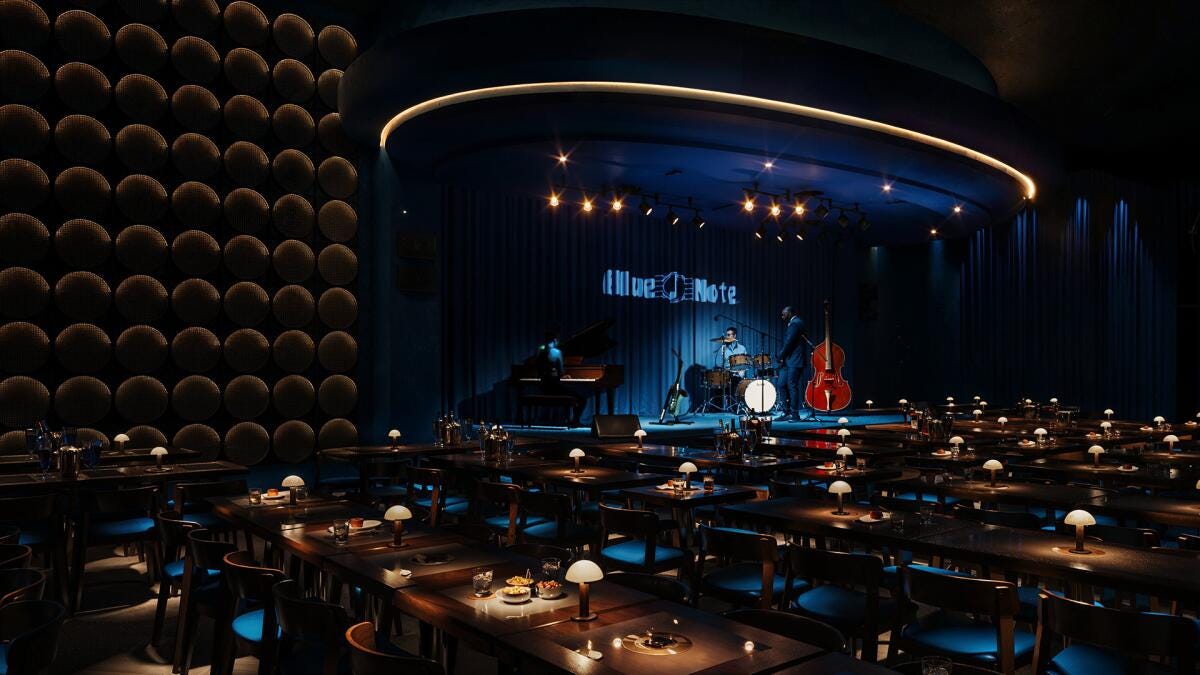
The Blue Note is an intimate room. That is not a limitation — it is the design. Seating capacity hovers around two hundred people, and the layout creates a close physical relationship between the stage and the audience that is fundamental to what happens musically when great artists perform there. When the ceiling is low and the tables are close and every breath the musicians take is audible in the room, something changes in the performance. Musicians respond to the intimacy. They play differently. They take chances they might not take in a concert hall. They communicate with the audience in a way that is impossible when you are playing to a thousand people from a distant stage. Read the Full Live Jazz Article on The Improv Cafe’ Substack!
The Blue Note Goes Global — A World Standard for Live Jazz
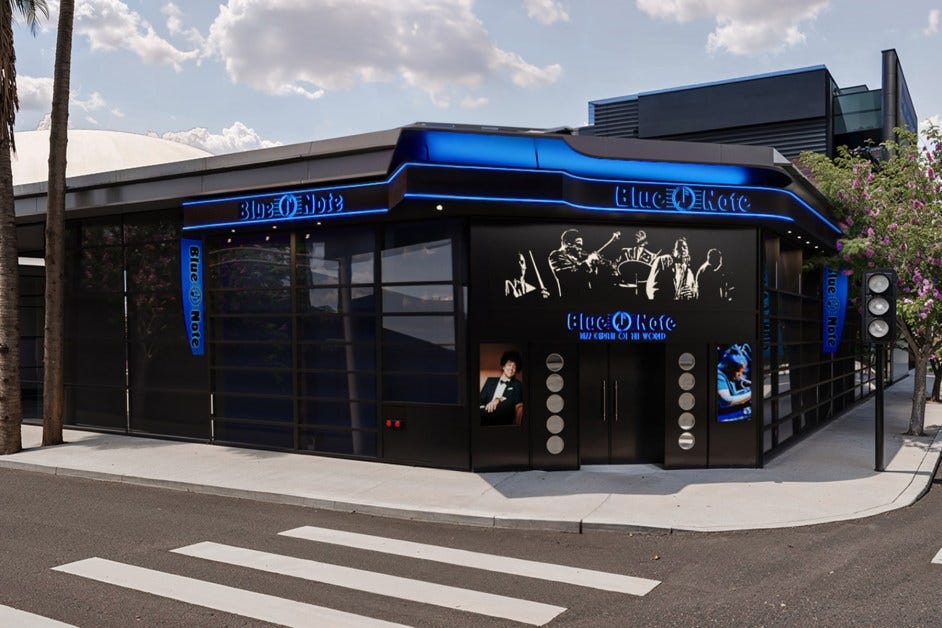
What began at a single address in Greenwich Village in 1981 has become one of the most recognized and respected names in live music anywhere on earth. The Blue Note brand now operates jazz clubs and restaurants across three continents, and the expansion has been guided by a consistent philosophy: wherever a Blue Note opens, it brings with it the intimacy, the programming excellence, and the deep commitment to live performance that made the original club legendary.
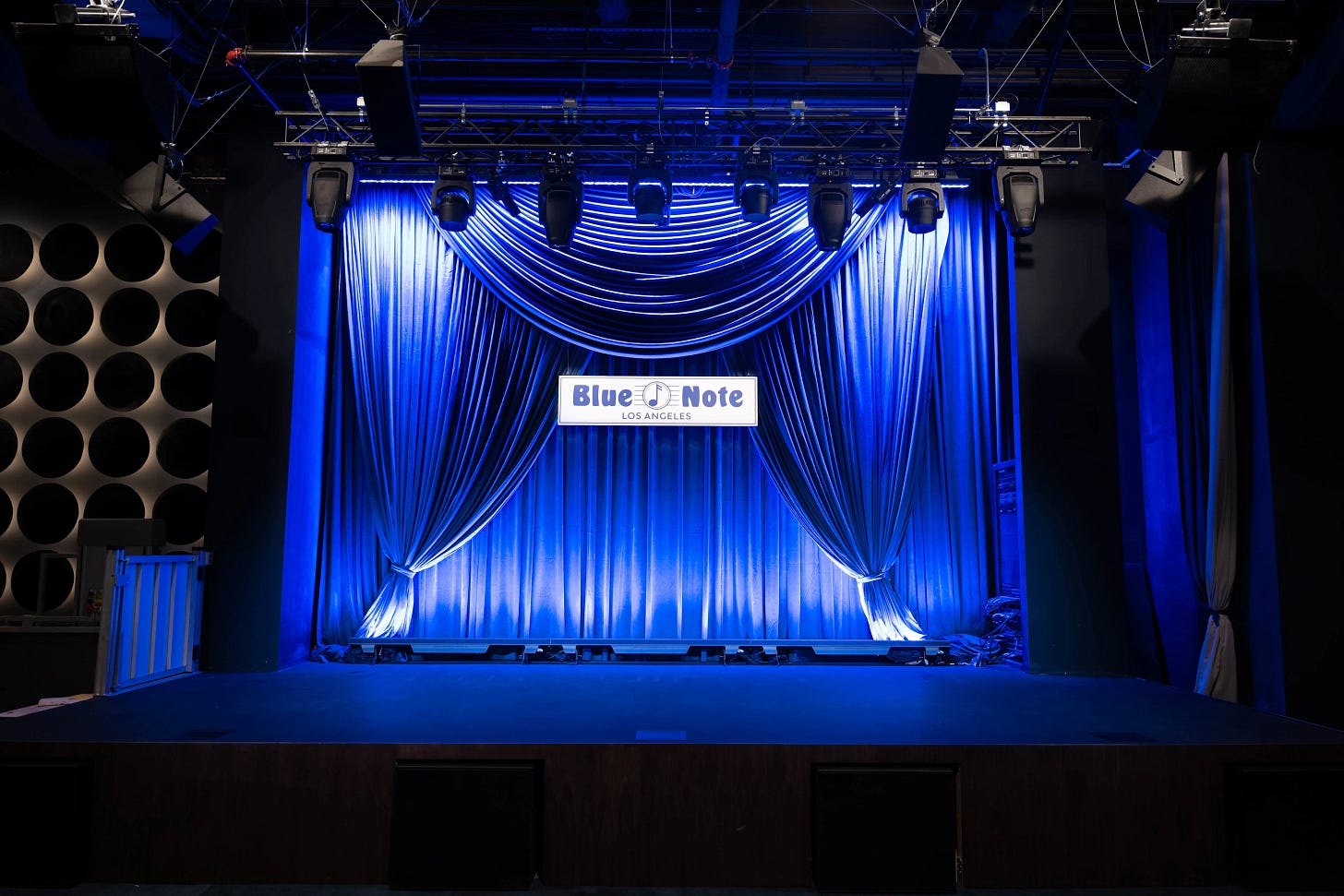
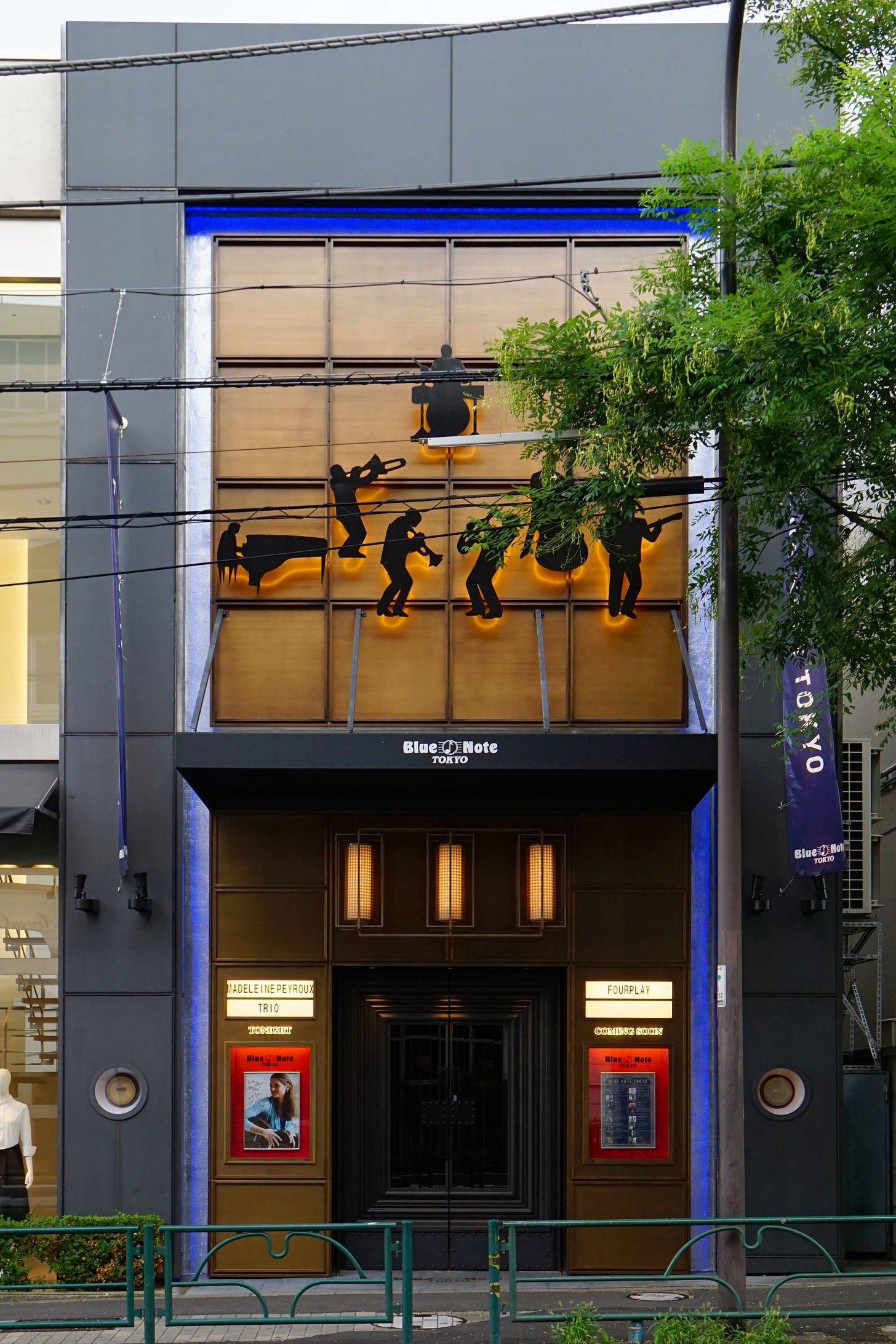
Blue Note Tokyo opened in 1988, becoming the international beachhead of what would eventually become a global family of venues. Over the subsequent decades, Blue Note locations opened in Rio de Janeiro and São Paulo in Brazil, Milan in Italy, Beijing and Shanghai in China, Waikiki in Hawaii, and Napa in California, each venue adapting the Blue Note ethos to its local culture while maintaining the core standard of world-class live music in an intimate setting. The most recent major addition came in 2025 with the opening of Blue Note Los Angeles, located on Sunset Boulevard in Hollywood, inaugurated by five-time Grammy winner Robert Glasper in a grand opening that underscored just how seriously the Blue Note takes the music it presents. Read the Full Live Jazz Article on The Improv Cafe’ Substack!
The Blue Note Jazz Festival: Bringing the Room to the World
Each June in New York City, the Blue Note extends its reach beyond the club walls through the annual Blue Note Jazz Festival, now in its 15th year and covering multiple venues across the city in a month-long celebration that has become one of the signature jazz events on the American calendar. The 2026 festival brings together an extraordinary roster of artists across the Blue Note Jazz Club, Sony Hall, and Capital One City Parks Foundation SummerStage, presenting performers ranging from Brian Blade and the Fellowship Band to Brandee Younger, from Chief Xian aTunde Adjuah to a lineup that reflects the full contemporary reach of the Blue Note programming philosophy — jazz at its core, but wide enough in its embrace to include the full spectrum of what improvised, live music can mean in 2026. Read the Full Live Jazz Article on The Improv Cafe’ Substack!
What Gets Captured — The Living Archive of Blue Note Live Recordings
One of the most significant contributions the Blue Note Jazz Club has made to the history of jazz is the extraordinary collection of live recordings that have been produced within its walls. These are not afterthoughts. They are not supplementary documentation. In many cases, the live albums recorded at the Blue Note represent the definitive statements of the artists who made them — performances where the combination of an intimate room, a present and engaged audience, and the particular chemistry of musicians who are in the zone together produced something that no subsequent studio session could touch.
Chick Corea’s relationship with the Blue Note as a performance space was one of the most productive in the history of the club. His legendary 70th birthday celebration at the club in 2011 brought together an astonishing gathering of musical friends and collaborators — Herbie Hancock, Bobby McFerrin, Wynton Marsalis, John McLaughlin, Stanley Clarke, Gary Burton, Brian Blade, Gary Peacock — across ten different bands performing over a month-long residency that produced one of the most comprehensive live documents in jazz history. The recordings from those nights capture jazz as it exists at its absolute summit: masters of the form playing together, supporting each other, challenging each other, and finding music that none of them could have reached alone. Read the Full Live Jazz Article on The Improv Cafe’ Substack!
The Improv Café and the Blue Note: A Shared Philosophy of the Real
There is a reason the Live at the Blue Note Radio Show belongs on The Improv Café specifically, and it has everything to do with what both the station and the club believe about music. The Blue Note was founded on the conviction that great artists performing live in an intimate setting, for an audience that showed up to listen, would produce something worth experiencing — something that people would return for, talk about, remember, and seek out again. That conviction has been vindicated over and over across four decades and ten countries, in rooms from Greenwich Village to Tokyo to Rio de Janeiro. Read the Full Live Jazz Article on The Improv Cafe’ Substack!
Beyond the Show: What The Improv Café Broadcasts Every Day
The Live at the Blue Note Radio Show is one chapter in The Improv Café’s programming, and it is a signature one — but the station’s commitment to live jazz extends across its entire schedule, seven days a week, through a series of shows that collectively cover the full landscape of what live jazz, big band, swing, and vocal performance have produced over the course of nearly a century.
The Swing with the Big Bands show on Friday nights is the station’s high-energy, dance-floor-ready celebration of the great live big band tradition — a weekly journey through the historic orchestral performances of Count Basie, Duke Ellington, Glenn Miller, Benny Goodman, Tommy Dorsey, Harry James, and every other master of the large ensemble jazz form. If Friday nights have a soundtrack, on The Improv Café it is the sound of twenty-piece orchestras playing at full power, captured live at ballrooms and concert halls and outdoor stages across decades of the music’s greatest era.
Singing with Swing on Sunday evenings shifts the lens to the vocal jazz tradition — the great singers who turned the American songbook into something personal and permanent, interpreting standards with the emotional depth and rhythmic sophistication that define the art form at its most intimate and compelling. This is the show where the voice becomes the instrument of jazz, and where Sunday evenings acquire a particular kind of warmth and reflection.
Live at the Village Vanguard, airing on Tuesdays and Wednesdays, brings listeners into the other great room in the American jazz landscape — the triangular basement in Greenwich Village where John Coltrane, Bill Evans, Miles Davis, and a hundred other architects of the music made the recordings that changed everything. The Vanguard is the counterpart to the Blue Note: older, more austere, its acoustics legendary, its stage the site of more landmark live recordings than almost any other venue on earth. On The Improv Café, listeners get hours of immersion in that legacy.
Taken together, these shows form a programming landscape that is unlike anything else in broadcasting. All live. All the time. Every note from a stage. Every moment a real moment.