There are certain names in jazz that immediately carry weight before a single note is played. The Blue Note is one of them. For decades, it has represented more than a venue or a brand—it has stood as a living institution tied directly to the evolution of modern jazz performance, artist development, improvisation, and live musical storytelling. As the 15th annual Blue Note Jazz Festival prepares to unfold across New York and Los Angeles this June, the festival arrives at a moment when live jazz continues to reclaim visibility, relevance, and cultural urgency on an international scale. For The Improv Cafe’, the radio station devoted entirely to live jazz, live big band, and live swing recordings, the significance of this year’s festival reaches far beyond a seasonal concert announcement. It represents another major chapter in the ongoing expansion of live performance culture itself.
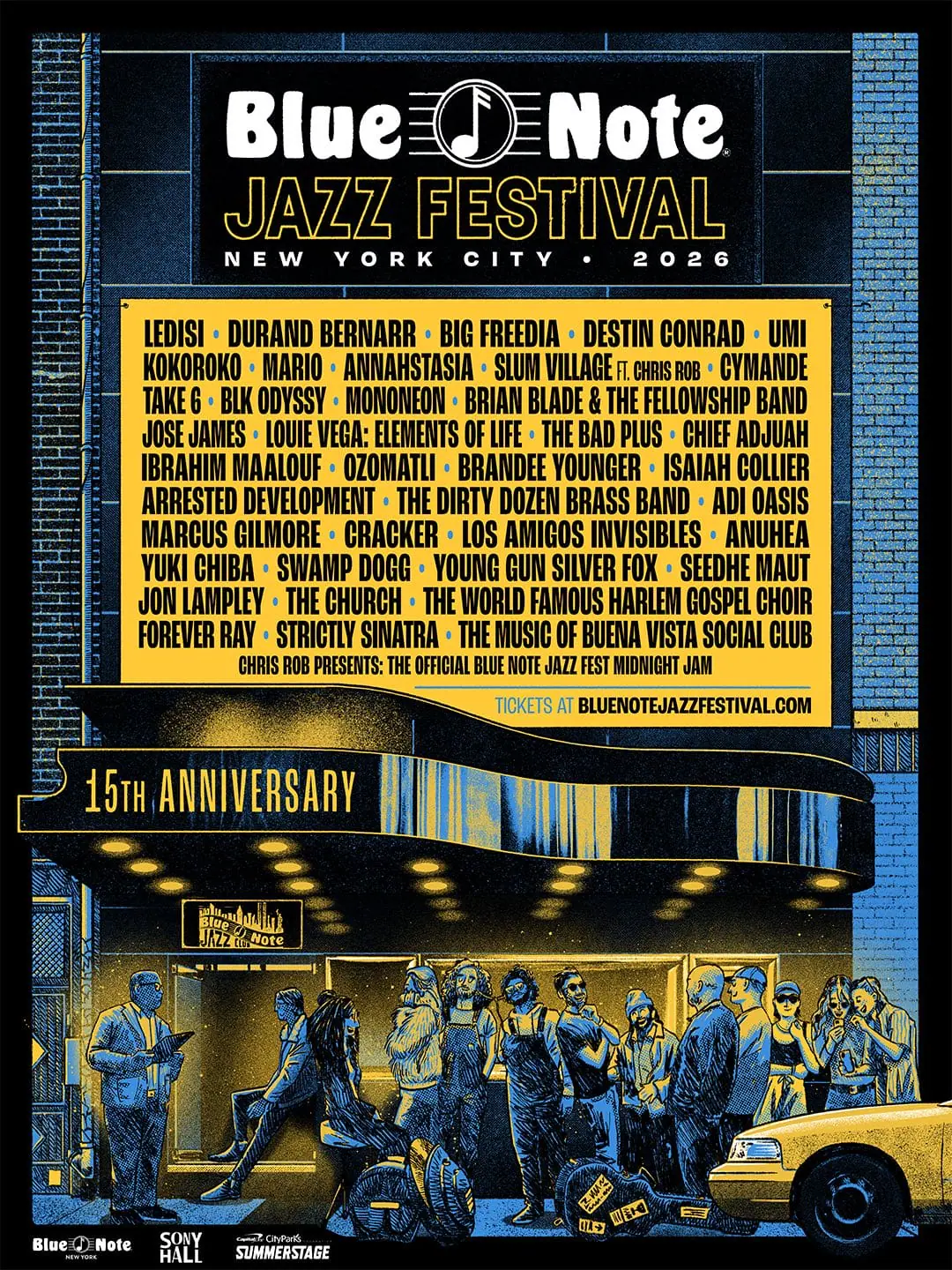
Beginning June 1 and extending through July 1 in New York, the Blue Note Jazz Festival once again transforms the city into a month-long network of performances centered around the legendary Greenwich Village club and Sony Hall. The scope of the programming reflects the increasingly broad definition of contemporary jazz presentation, embracing traditional musicianship while acknowledging the genre’s continued fusion with soul, funk, hip-hop, rhythm and blues, Afro-futurism, and modern improvisational forms. This year’s lineup captures that intersection perfectly, bringing together artists who approach jazz not as a fixed historical artifact but as an active and evolving language.
Among the featured performers are powerhouse vocalist Ledisi, New Orleans cultural innovator Big Freedia, genre-defying vocalist Durand Bernarr, and the groundbreaking British funk collective Cymande. Individually, each artist occupies a distinct space in contemporary music. Together, they represent the widening orbit of modern jazz festivals, where improvisation and groove continue to influence virtually every corner of contemporary live performance.
The festival’s expansion beyond New York remains equally important. On June 13 and 14, the Blue Note Jazz Festival returns to the iconic Hollywood Bowl for a major weekend showcase that blends jazz, soul, and cross-generational collaboration on one of America’s most historic outdoor stages. The lineup reflects both legacy and forward momentum, featuring enduring icons like Patti LaBelle alongside globally recognized artist Wyclef Jean and acclaimed jazz vocalist Gregory Porter.
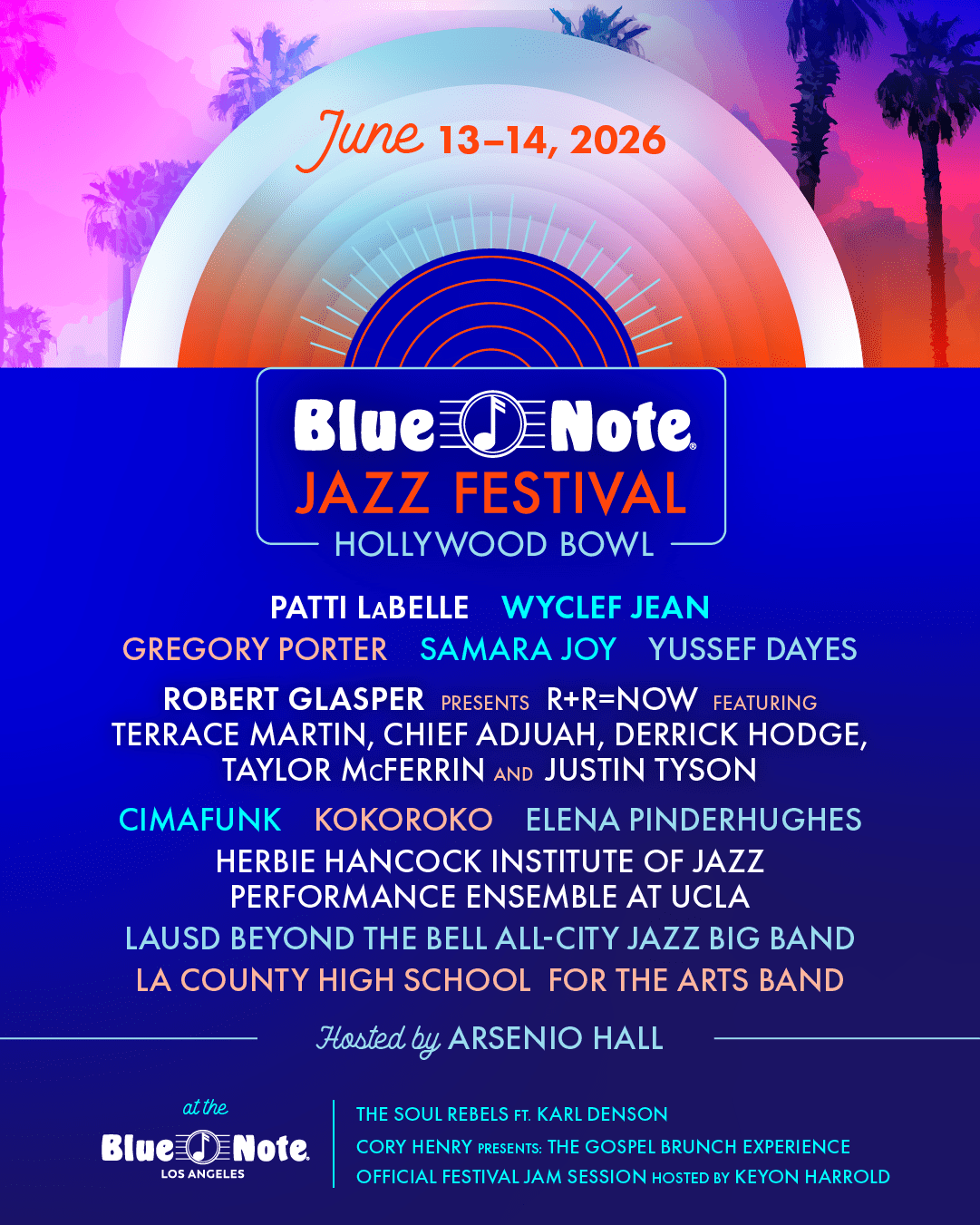
One of the defining centerpieces of the Hollywood Bowl programming is the return of Robert Glasper’s R+R=NOW collective, a project that has become one of the most influential examples of jazz fusion in the modern era. Featuring contributions from musicians including Terrace Martin and Chief Adjuah, the ensemble represents a new generation of artists refusing to isolate jazz from the rest of contemporary Black music traditions. Their work pulls equally from improvisation, hip-hop production, electronic textures, and deeply rooted rhythmic structures while maintaining the spontaneity that defines great live performance.
That connection between improvisation and immediacy remains central to why festivals like Blue Note continue to matter. In an era increasingly dominated by algorithmic listening, compressed streaming playlists, and isolated digital consumption, live jazz restores unpredictability to the center of the musical experience. Every performance becomes singular. Every solo evolves in real time. Every audience changes the shape of the room. It is one of the few genres where the act of listening remains inseparable from the act of witnessing.
That philosophy sits at the core of The Improv Cafe’ itself. The station’s commitment to exclusively broadcasting live recordings is not nostalgia-driven programming—it is preservation through performance. Whether the music originates from a legendary jazz club, a major concert hall, a ballroom packed with swing dancers, or a late-night small ensemble session captured directly to tape, the focus remains fixed on authenticity and atmosphere. The audience hears the crowd reaction, the room acoustics, the spontaneous interplay between musicians, and the imperfections that make live jazz human in the first place.
That same spirit defines tonight’s “Live at The Blue Note” radio show on The Improv Cafe’. Built entirely around music recorded live in clubs or captured directly during album and concert performances, the program functions as both celebration and documentation of jazz in its most natural environment. These are not sterilized studio reconstructions. They are living performances filled with the tension, momentum, and communication that only occur when musicians are responding directly to one another in real time.
For jazz audiences, the club environment has always mattered. Rooms like the original Blue Note became legendary because they created conditions where experimentation could happen nightly in front of listeners who understood that the music was never meant to remain static. The applause between solos, the extended improvisations that stretched beyond studio limitations, the moments where musicians took risks without certainty of where the performance might land—those experiences shaped the identity of jazz itself.
The modern Blue Note Jazz Festival continues that lineage while simultaneously redefining what jazz presentation can look like in 2026. It understands that jazz history and innovation are not opposing forces. Artists like Gregory Porter carry vocal traditions tied directly to classic jazz phrasing while speaking to modern audiences. Robert Glasper’s projects openly blend electronic production and hip-hop influences without abandoning improvisational depth. Cymande’s long-standing influence on funk and soul culture continues to resonate through younger generations of musicians rediscovering groove-centered live performance.
This broader expansion of jazz culture is one reason festivals like Blue Note have become increasingly important globally. They are no longer confined to narrow genre audiences. They function as cultural crossroads where multiple generations, traditions, and musical languages intersect under the umbrella of live improvisational music. And importantly, they reaffirm that audiences are still actively searching for real performance experiences that cannot be replicated through short-form digital consumption.
For The Improv Cafe’, that mission remains constant every hour of the day. The station’s identity is rooted entirely in live music because live music creates permanence through impermanence. No two performances are identical. No audience hears the exact same version twice. Whether it is a roaring live big band arrangement, an intimate vocal jazz recording, a late-night trumpet solo echoing through a crowded club, or a swinging ballroom orchestra driving dancers across the floor, the power comes from the fact that the moment existed once and was captured honestly.
As the Blue Note Jazz Festival prepares to launch another major summer season across New York and Los Angeles, its broader impact becomes increasingly clear. Live jazz is not retreating into history. It is adapting, expanding, and finding new audiences without abandoning the core principles that built it. The musicians continue evolving. The audiences continue growing. The clubs remain vital. The festivals continue scaling internationally. And stations like The Improv Cafe’ continue serving as one of the few remaining spaces where live jazz, live swing, and live big band music remain the entire focus rather than a side category buried inside a larger format.
Tonight’s “Live at The Blue Note” radio show carries that tradition forward in the purest way possible: real performances, real rooms, real audiences, and the unmistakable energy that only live jazz can create.
Live Club Highlights: May 2026. If you are traveling, here is what’s on the stage this month:
| Location | Key Performances (May 2026) | Unique Features |
|---|---|---|
| Tokyo | Candy Dulfer (May 10–13), Arturo Sandoval (May 25–27), Dee Dee Bridgewater (May 30–31) | Often features “Premium Live” sets with specialized menus. |
| Milan | Sarah Jane Morris (May 8–9), Veronica Swift (May 13), Joshua Redman (May 15) | One of the largest outposts, known for its extensive Italian-fusion dinner menu. |
| New York | The Terrace Martin Residency (May 12–17 & 26–31), Kenny Garrett (May 22–24) | The original “intimate” basement setting in Greenwich Village. |