The 2026 Newport Jazz Festival is no longer simply another major summer music event on the calendar. This year’s announcement signals something much larger for the modern jazz world: a generational transition happening in real time at one of the most historically significant festivals ever created. Set for July 31 through August 2 at Fort Adams State Park in Newport, Rhode Island, the legendary gathering returns with a lineup that bridges classic jazz artistry, progressive improvisation, modern soul, funk experimentation, global fusion, and boundary-pushing contemporary performance in a way that feels entirely aligned with where live music is heading next.
For The Improv Cafe’, a station dedicated exclusively to live jazz, live big band, and live swing performances, the 2026 Newport Jazz Festival represents the exact type of artistic evolution that continues keeping improvisational music culturally relevant across generations. This year’s festival does not rely solely on nostalgia or historical prestige. Instead, it actively positions jazz as a living, expanding form capable of connecting legacy artists, emerging innovators, cross-genre collaborators, and younger audiences inside one of the most respected performance environments in modern music history.
The 2026 edition also introduces a major artistic shift behind the scenes. Grammy-winning drummer, producer, composer, and bandleader Nate Smith officially steps into a defining leadership role as the festival enters a new era under his artistic direction. That change alone carries enormous significance throughout the jazz world. Smith has spent years building credibility not only among traditional jazz audiences, but also across funk, fusion, hip-hop, R&B, modern improvisation, and experimental performance communities. His influence reflects the exact kind of fluid musical language increasingly shaping contemporary jazz culture worldwide.
Rather than programming the festival strictly around genre purity, the 2026 Newport Jazz Festival embraces musical conversation itself. The lineup reflects a philosophy built around rhythm, improvisation, spontaneity, groove, collaboration, storytelling, and live performance chemistry. That approach feels deeply connected to Newport’s original identity while also acknowledging how modern audiences experience jazz today — not as an isolated style, but as a constantly evolving musical ecosystem.
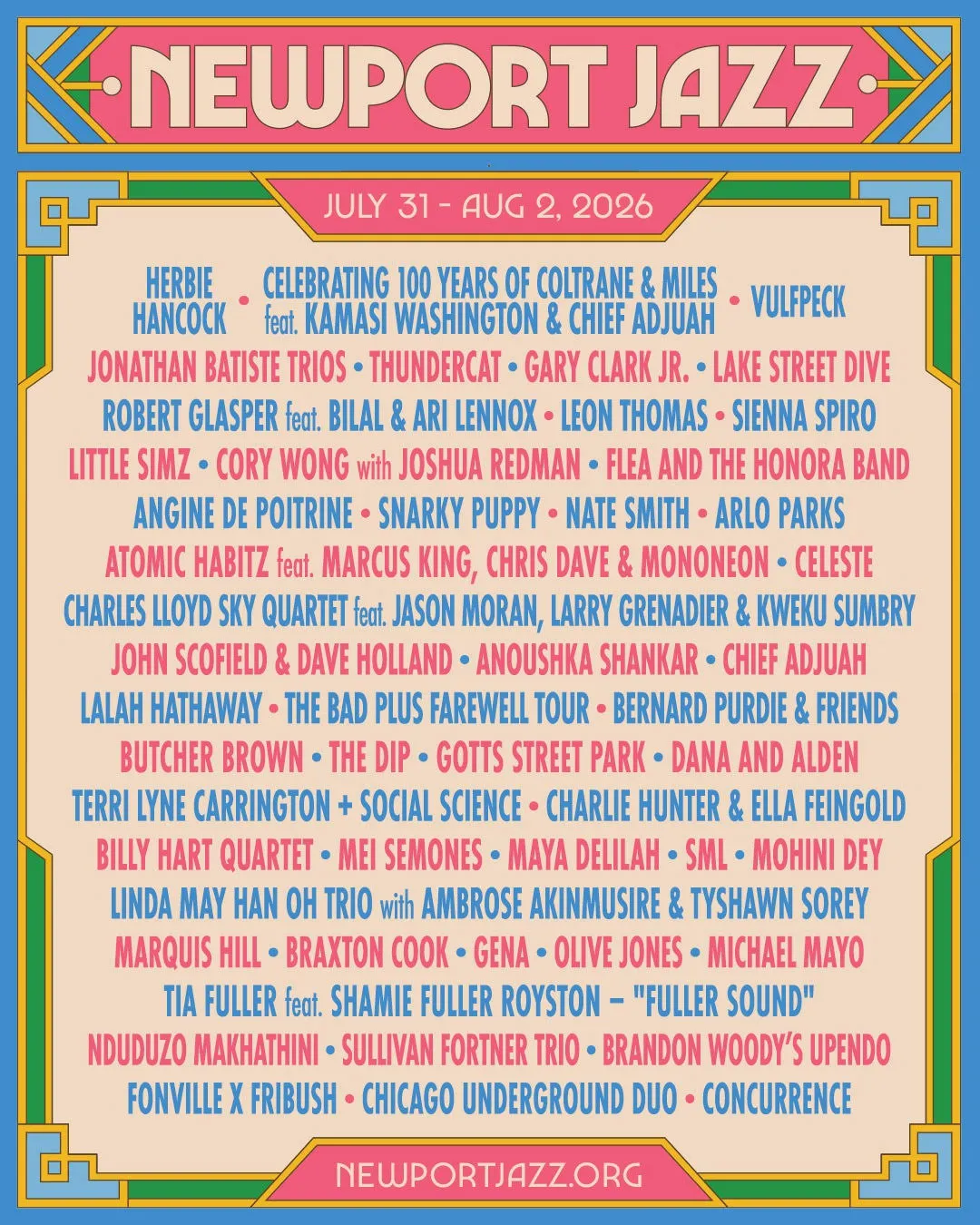
The headline roster alone immediately establishes the scale of the weekend. Herbie Hancock returns as one of the defining figures of modern jazz piano and one of the last remaining living architects of multiple jazz revolutions spanning acoustic post-bop, electric fusion, funk experimentation, and advanced contemporary improvisation. Hancock’s presence at Newport immediately elevates the entire festival because his performances are never merely retrospective celebrations. Every live appearance continues demonstrating how jazz innovation remains active rather than archival.
Jon Batiste arrives at Newport carrying one of the broadest creative profiles in modern music. His ability to merge jazz, gospel, soul, improvisation, rhythm and blues, classical influences, New Orleans traditions, and contemporary performance art has transformed him into one of the most recognizable ambassadors for live musicianship in mainstream culture. His trio format at Newport could become one of the weekend’s defining performances because stripped-down live settings often reveal the deepest improvisational instincts behind major artists.
Thundercat’s inclusion further confirms Newport’s commitment to modern musical evolution. As both a virtuoso bassist and an unpredictable live performer, Thundercat exists in a space where jazz harmony, funk grooves, fusion textures, electronic experimentation, and psychedelic performance aesthetics coexist naturally. His audience also represents an entirely different generation discovering improvisational music through contemporary cultural pathways rather than traditional jazz institutions.
Then comes Vulfpeck, whose arrival at Newport may initially surprise some traditionalists, but actually makes perfect sense within the broader trajectory of modern live performance culture. Few contemporary bands understand groove dynamics, live musicianship, audience interaction, rhythmic precision, and improvisational energy quite like Vulfpeck. Their stripped-down funk minimalism and performance spontaneity embody many of the same principles that have always driven jazz itself.
Still, one of the most important artistic centerpieces of the entire 2026 festival may be the major centennial tribute honoring the 100th birthdays of Miles Davis and John Coltrane. Few names carry greater historical weight in jazz history, and Newport’s decision to build a large-scale performance celebration around their legacy gives the weekend a deeper emotional and cultural gravity beyond standard festival programming.
The tribute featuring Kamasi Washington and Chief Adjuah immediately signals that this will not simply be a museum-style retrospective. Instead, it appears positioned as a living reinterpretation of revolutionary jazz ideals through contemporary voices still actively reshaping the genre. Kamasi Washington has become one of the most influential large-scale jazz composers and saxophonists of the modern era, helping reintroduce expansive spiritual jazz concepts to younger audiences worldwide. Chief Adjuah, formerly known as Christian Scott, continues pushing jazz into radically modern territory through rhythmic experimentation, cultural fusion, and advanced compositional structures that challenge traditional genre limitations.
The symbolic importance of celebrating Miles Davis and John Coltrane in 2026 cannot be overstated. Their innovations permanently altered not only jazz, but the broader direction of modern music itself. Davis continuously reinvented the possibilities of jazz performance throughout multiple decades, while Coltrane transformed improvisation into something spiritual, philosophical, emotional, and transcendent. Newport placing their centennial celebration at the center of the weekend reinforces the festival’s ongoing role as both a historical institution and a platform for future artistic expansion.
Beyond the major headliners, the depth of the 2026 lineup may ultimately become the festival’s greatest strength. Robert Glasper featuring Bilal and Ari Lennox creates one of the weekend’s most anticipated intersections between jazz, neo-soul, improvisation, and contemporary R&B. Glasper has spent years dismantling the barriers separating jazz from mainstream Black music traditions, and his collaborations consistently produce performances that feel both technically sophisticated and emotionally immediate.
Gary Clark Jr.’s appearance introduces another layer of stylistic diversity while still remaining connected to the improvisational DNA at the heart of blues and jazz traditions. His guitar work often merges blues structure, rock intensity, soul phrasing, and extended live improvisation in ways that naturally complement Newport’s broader musical identity.
Little Simz represents another fascinating inclusion because her artistry reflects how modern jazz influence increasingly extends into hip-hop production, spoken-word rhythm, orchestral arrangement, and conceptual live performance. Arlo Parks brings a quieter but equally compelling emotional intimacy through songwriting that frequently draws from jazz textures, atmospheric arrangements, and poetic storytelling traditions.
Meanwhile, longtime jazz stalwarts continue grounding the festival in deep musical lineage. Charles Lloyd remains one of the most spiritually resonant saxophonists in modern jazz history. John Scofield continues blending advanced harmonic improvisation with blues, funk, and fusion vocabulary that has influenced generations of guitarists. Terri Lyne Carrington’s Social Science project represents one of the most intellectually ambitious contemporary jazz ensembles currently touring, combining social commentary, rhythmic innovation, and collaborative experimentation into a uniquely modern artistic statement.
The daily festival structure also reveals careful programming balance across the entire weekend. Friday immediately establishes an adventurous tone with Vulfpeck, Robert Glasper, Little Simz, Charles Lloyd, Chief Adjuah, and Anoushka Shankar all appearing on the same day. That combination alone captures Newport’s expanding identity — global influences, improvisation, groove-based performance, jazz lineage, and experimental modern artistry coexisting inside one schedule.
Saturday may ultimately emerge as the festival’s most explosive day musically. Kamasi Washington, Jon Batiste, Gary Clark Jr., Snarky Puppy, Cory Wong, and Terri Lyne Carrington create an extraordinarily dynamic lineup built around rhythmic energy, improvisational freedom, technical precision, and live audience connection. Snarky Puppy alone has become one of the most important live ensemble acts of the past decade because of its ability to merge jazz complexity with crowd-driven excitement.
Sunday closes the festival with a combination of iconic prestige and stylistic unpredictability. Herbie Hancock’s appearance naturally serves as a centerpiece, while Thundercat, Lake Street Dive, Flea with the Honora Band, Arlo Parks, and The Bad Plus collectively ensure the weekend concludes with both musical sophistication and broad audience accessibility.
What makes the 2026 Newport Jazz Festival especially compelling is how intentionally it reflects the current state of live jazz culture itself. Modern jazz audiences are no longer confined to one demographic, one listening habit, one streaming category, or one stylistic expectation. Today’s listeners move fluidly between jazz, funk, soul, hip-hop, electronic music, experimental composition, global fusion, and improvisational performance traditions. Newport’s programming recognizes that reality without abandoning its historical roots.
That balance matters because many legacy festivals struggle to evolve without alienating longtime audiences. Newport instead appears to understand that jazz history itself was always built on innovation, disruption, experimentation, and cultural expansion. The genre has never remained static for long periods. Every major jazz movement initially challenged existing definitions before eventually becoming accepted tradition.
The atmosphere surrounding Fort Adams State Park only amplifies the experience further. Few festival settings in America offer the same combination of waterfront scenery, historical significance, outdoor acoustics, and communal live music culture. Newport has always carried an energy that feels larger than a typical festival weekend because audiences understand they are participating in an ongoing musical legacy stretching back decades.
For The Improv Cafe’, the 2026 Newport Jazz Festival serves as a reminder of why live performance remains the center of jazz culture regardless of technological change. Recorded music can preserve brilliance, but improvisation only fully exists in the moment it is created. That unpredictability — the risk, spontaneity, interaction, and emotional immediacy between musicians and audiences — continues defining the power of jazz more than any streaming platform, playlist algorithm, or commercial trend ever could.
The sold-out status of all official three-day and single-day passes further reinforces the growing demand for authentic live musical experiences. Even in an era dominated by digital access and endless content saturation, audiences continue gravitating toward festivals capable of delivering genuine artistic connection. The continued activity on fan exchange platforms and secondary ticket markets only demonstrates how strong the demand remains for Newport’s unique cultural position.
More importantly, the 2026 festival lineup suggests that jazz is not retreating into preservation mode. It is expanding outward again. Younger audiences are discovering improvisational music through artists like Thundercat, Kamasi Washington, Robert Glasper, Cory Wong, and Snarky Puppy. Longtime listeners continue following masters like Herbie Hancock, Charles Lloyd, and John Scofield. Newport successfully places those worlds together without forcing either side to compromise its identity.
That may ultimately become the defining achievement of the 2026 Newport Jazz Festival. It does not present jazz as a closed historical institution. It presents jazz as a living language still capable of adapting, collaborating, evolving, and leading contemporary music culture forward.
And for a station like The Improv Cafe’, which exists entirely to celebrate the enduring energy of live jazz, live big band, and live swing performance, that vision could not feel more relevant heading into one of the most anticipated weekends of the 2026 live music calendar.