Tonight on The Improv Café — Swing with the Big Bands Is On the Air
There is a moment that every true jazz lover knows. It happens somewhere between the first downbeat and the moment the horns lock in and the rhythm section finds its groove. The room shifts. The air changes. Something electric and undeniable takes over — and no matter where you are, no matter what you were doing before you pressed play, you are suddenly there. In the room. In the music. In the moment. That is exactly what The Improv Café Radio Station delivers, without exception, every single time you tune in — because every track broadcast on this station is the live version, and tonight, that experience reaches its most joyful and swinging height with the return of Swing with the Big Bands, our signature Friday night radio show.
This is not background music. This is not a playlist algorithm selecting familiar titles to fill your evening. This is a commitment — a deep, unwavering, broadcast-level commitment — to the most powerful thing live jazz has ever offered: the truth of what happened in the room when the musicians were playing. Tonight, that truth comes in the form of legendary big band performances, captured live, broadcast with full fidelity, and designed to make you do the one thing great swing music has always demanded. Move. Dance. Feel it. Let it in.
So tune in. Bop. Swing. Let these performances do what only live jazz can do — reach through your speakers, grab you by the rhythm, and carry you somewhere remarkable.
The Only Station That Only Plays Live
Before we go further, it is worth stating plainly what makes The Improv Café unlike anything else in radio: this station exists on a single, non-negotiable principle. Every song played is the live version. Not a studio approximation. Not a polished, overdubbed, carefully constructed recording engineered for sonic cleanliness. Every track — every saxophone run, every trumpet break, every bass groove and brushed snare — comes from a live performance. A real room. A real audience. A real moment in time that was captured and preserved so that you could experience it as close as possible to the way the people in the venue did when it happened.
Live Jazz. Live Big Band. Live Swing. Vocal Jazz performed live. That is the programming. That is the format. That is The Improv Café.
In a media world overrun with algorithms, artificial enhancement, and perfectly sculpted audio designed to satisfy the widest possible demographic with the least possible risk, The Improv Café takes the opposite approach. It goes deeper. It goes realer. It trusts the listener enough to give them the thing itself — not the sanitized version, not the commercially friendly edit, but the genuine, spontaneous, irreplaceable live performance, in all its stunning and sometimes breathtaking unpredictability.
You hear the room. You hear the audience react when a soloist does something unexpected. You hear the tension that builds in the bars before a climactic horn section explodes. You hear musicians talking to one another through their instruments in real time, making decisions on the fly, taking risks, and landing somewhere extraordinary. You cannot manufacture that in a studio. You cannot reproduce it with technology. It happens live, or it does not happen at all — and on The Improv Café, it happens every time you tune in.
This is why the station matters. This is why it is not just another jazz radio station. It is the only all-live jazz radio station, and it has built an audience of listeners who understand exactly what that means and why it is the only way to experience this music.
Tonight: Swing with the Big Bands — Friday Night’s Essential Radio Experience
If you are looking for the perfect way to spend a Friday evening — whether you are cooking, entertaining, dancing in your living room, or simply letting great music fill your space — tonight’s Swing with the Big Bands radio show on The Improv Café is where you want to be. This is the program that has become the heartbeat of Friday nights on the station, and it earns that distinction every single week with programming rooted in the most exhilarating live big band recordings ever captured on tape.
The show draws from the full, magnificent sweep of big band history — the soaring orchestral arrangements of the 1930s and 40s when swing was America’s popular music and every ballroom from Harlem to Hollywood was packed with dancers; the bebop-infused evolution of the 1950s when large ensembles began pushing into more complex harmonic territory; the jazz orchestra traditions that carried the sound through decades of change; and the contemporary big bands that continue to perform, tour, and record today, keeping this magnificent American art form vital, relevant, and impossible to ignore.
You will hear the titanic charts of Count Basie, where rhythm is everything and the whole thing swings from the very first note. You will hear the precision and romance of Glenn Miller, the adventurous harmonic sophistication of Duke Ellington, the thunderous drum showmanship of Gene Krupa, the silky clarinet mastery of Benny Goodman, the fiery trumpet of Harry James, and the gorgeous trombone ballads of Tommy Dorsey. These are the architects. These are the people who built the language of big band jazz and taught the world what it meant for an orchestra to truly swing.
And tonight, their music plays live. The way it was always meant to be heard.
So dance. Move. Bop along. Let the horns carry you. Let the rhythm section push you. Let the full power of a twenty-piece orchestra performing at peak live energy remind you why this music has endured for nearly a century and why it still has the power to stop a room and start a dance floor. Tune in tonight on The Improv Café, and let the Swing with the Big Bands show deliver the Friday night your ears have been waiting for.
Summer 2026 and the Big Band World Is Alive
It would be easy to frame what is happening across the big band and swing world right now as a revival. That word gets used frequently, as if the music had gone somewhere and is now returning. But here is the more accurate and more exciting truth: big band jazz and live swing never went away. They continued. They evolved. They found new audiences while maintaining the devotion of dedicated fans who never stopped showing up to hear the music live. What is happening in summer 2026 is not a revival so much as an eruption — a moment when the scale of what was always there becomes visible to a much wider audience, and the full, glorious weight of this American musical tradition announces itself with force and conviction.
From major anniversary tours to outdoor ballroom concerts, from massive multi-day festivals to intimate jazz club residencies, from the Hudson River waterfront in Manhattan to the rolling hills of upstate New York to the Midwest festival circuit — the summer of 2026 is overflowing with big band, swing, and live jazz, and The Improv Café is here to document, celebrate, and soundtrack every moment of it.
Swingtime Big Band Marks Fifty Years of Making America Dance
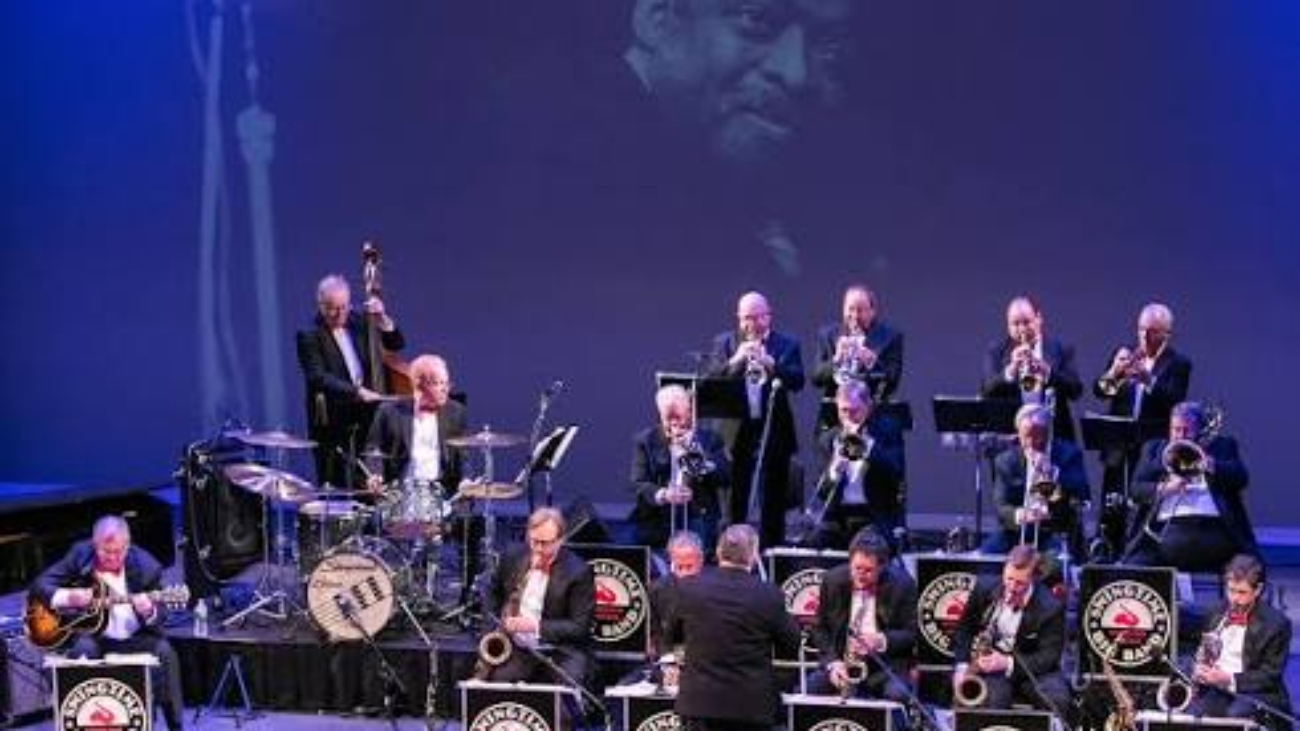
There are ensembles that perform and ensembles that endure. The Swingtime Big Band, led by artistic director and saxophonist Steve Shaiman, is firmly in the second category. This summer, the 20-piece band is celebrating its 50th anniversary of performing for concert audiences and ballroom dancers alike, a milestone that represents not just longevity but an unbroken commitment to a musical tradition that Shaiman has made his life’s work.
Hailed by the New York Times as musicians who make the sounds of the pre-rock era rock, and recognized by the Big Band Hall of Fame as Ambassadors of Big Band Music, Swingtime has earned every superlative it has received. The ensemble specializes in what it does better than almost anyone working today: historically precise, authentically arranged live recreations of the great swing era orchestras. When Swingtime plays a Count Basie chart, it sounds like Count Basie. When it plays Glenn Miller, you hear Glenn Miller’s America. When it plays Duke Ellington, the elegance and complexity of that singular musical mind come through with full clarity.
What makes a Swingtime Big Band performance something more than mere recreation is Shaiman himself. Between numbers, he shares the historical context of each piece — who wrote it, what it meant, how it fit into the arc of jazz history — turning a concert into something closer to an education. Audiences leave knowing more than they arrived with, and they leave having danced, because Swingtime’s live sound makes dancing not just an option but an inevitability. The band features vocalists who inhabit the classic big band vocal tradition with authenticity and joy, bringing the sounds of Ella Fitzgerald, Peggy Lee, Frank Sinatra, Dean Martin, and Nat King Cole to life alongside the soaring horn charts.
The 50th anniversary touring schedule for summer 2026 includes outdoor ballroom events where the full twenty-piece ensemble brings authentic swing to audiences who may be experiencing this music live for the first time. For many of them, it will be one of the most unexpectedly moving nights of their year. That is what Swingtime does. It opens a door into something timeless and invites everyone through.
The Compaq Big Band and the America 250 Celebration
The nation’s 250th birthday is being celebrated across the country in 2026 with events of every scale and style, and the big band world is contributing to that celebration in a way that feels entirely appropriate — because the golden era of the American big band and the mid-20th century flowering of American culture are inseparable parts of the same story.
The 19-piece Compaq Big Band has secured one of the most anticipated headline slots of the holiday season: a free outdoor concert on July 3rd — a celebration billed as the “4thEve” — at the Hopkinton Center for the Arts in Massachusetts. The event brings together a full professional orchestra and features vocalist Julia Danielle, winner of the prestigious 2022 Ella Fitzgerald Competition. That combination — the full, powerful sound of a 19-piece big band in an outdoor summer setting, paired with a vocalist of Danielle’s caliber and pedigree — promises a concert that will draw audiences from across the region and send them home having experienced exactly what a live big band in full flight can do.
Free, outdoor, and set against the backdrop of a national birthday celebration, this concert is a reminder that big band jazz has always been a democratic music. It was born in dance halls and ballrooms that were open to everyone. It was broadcast on radio into living rooms across America. It belonged to the people who danced to it, and in Hopkinton on the eve of Independence Day, it will belong to them again.
Rochester International Jazz Festival: A Nine-Day Immersion in Everything Live Jazz Offers
The Rochester International Jazz Festival — now in its 23rd edition, running from June 19 through June 27, 2026 — is one of the most impressive jazz events in North America, and this year’s edition demonstrates exactly why. Over nine days, more than 1,750 artists perform across 19 indoor and outdoor venues in downtown Rochester, New York, in a European-style festival format that allows dedicated listeners to experience multiple performances every single night across a walkable circuit of world-class spaces.
The scale is staggering: more than 300 shows, over 110 of which are completely free. Headliners at Kodak Hall at Eastman Theatre this year include Grammy-winning trumpeter Chris Botti, the legendary “Empress of Soul” Gladys Knight, and — directly in the spirit of everything The Improv Café represents — the Legendary Count Basie Orchestra, performing on the final night of the festival with the full power and precision that has defined that institution for decades.
One of the festival’s defining features is its 25-year partnership with the Eastman School of Music at the University of Rochester, one of the most respected music conservatories in the world. That partnership means that woven throughout 300 shows and across every corner of the festival’s massive programming grid are performances from Eastman students, alumni, and faculty — from the Joey Stempien Big Band featuring current students to faculty-led ensembles that showcase the depth of jazz education being pursued at the highest level. Free jazz workshops run daily during the festival at the Eastman School itself, hosted by working professionals performing at the event, offering music students of all ages direct access to some of the most knowledgeable jazz musicians currently working.
This is what a thriving jazz ecosystem looks like. Not a single event or a single venue, but an entire city given over for nine days to the full spectrum of the art form — from world-famous headliners to collegiate talent to late-night jam sessions where anything can happen and often does. The Rochester International Jazz Festival is jazz in full bloom, and it is happening right now.
The Midwest Gypsy Swing Fest and the Living Spirit of Django
While the big band tradition draws from the orchestral roots of American swing, another deeply significant branch of the live swing world draws from a different but equally compelling tradition: the Gypsy jazz pioneered by Django Reinhardt and Stéphane Grappelli in the cafés and concert halls of 1930s Europe. That tradition is alive, well, and gathering for an exceptional two-day celebration this September.
The Midwest Gypsy Swing Fest, scheduled for September 11 and 12, 2026, has released its full performance roster, and it is a remarkable lineup. The Gonzalo Bergara Trio brings the Argentinian guitarist’s extraordinary technique and deep musical personality to the Midwest stage — Bergara is among the most respected voices in contemporary Gypsy jazz, capable of playing with breathtaking speed and equally breathtaking sensitivity. The Hot Club of Baltimore, co-founded by Michael Joseph Harris, brings the full spirit of the Hot Club tradition — rhythm guitars driving in a propulsive cascade beneath a singing lead — to a performance that will remind audiences why this particular sound, once heard, is impossible to forget. The Harmonious Wail Quartet rounds out a lineup that spans the full reach of the genre, from its Parisian roots to its contemporary American expressions.
Gypsy swing is a live music tradition in perhaps the most essential sense: it grew up in places where people gathered to hear musicians play in real time, without amplification, in close proximity to the audience. The energy of a great Gypsy jazz performance is inseparable from the physical experience of being in the room, and the Midwest Gypsy Swing Fest honors that tradition by bringing it out of the headphones and into the communal space of shared live music. September 11 and 12 in the Midwest — mark the calendar.
The Lindy Hop Is Back and It Is Bringing the Whole Ballroom with It
No conversation about live big band and swing in 2026 is complete without acknowledging the extraordinary resurgence of Lindy Hop — the American vernacular jazz dance that was born in Harlem in the late 1920s and reached its cultural peak in the ballrooms of the 1930s and 40s, where it was inseparable from the big bands that provided its soundtrack. That dance form never fully disappeared, but what is happening with it now, in 2026, is something more than maintenance. It is a full-scale renaissance.
The evidence is everywhere. On May 23rd of this year, the flight deck and hangar of the Intrepid Sea, Air & Space Museum in Manhattan was transformed into one of the most spectacular swing dance events in recent memory for the Battle of the Big Bands, a collaboration between the Intrepid Museum and Prohibition Productions. Two of the finest big bands in the country went head-to-head on a massive stage set against a 3,200-square-foot wooden dance floor — on a World War II aircraft carrier commissioned in 1943, at the literal height of the Swing Era. The event celebrated America’s 250th anniversary in a way that felt historically resonant rather than nostalgic, because the music and the dancing were happening right now, alive and real, on a ship that carries the same era in its bones. Lindy hop competitions, a vintage fashion parade curated by a fashion historian, and a free beginner swing dance lesson ensured that the event was as welcoming to newcomers as it was rewarding for veterans.
That energy is flowing directly into Western & Swing Week 2026 at the Ashokan Center in upstate New York, where a legendary staff lineup is converging for one of the most beloved live-orchestra swing dance camps in the country. This year’s Lindy Hop faculty brings together a genuinely exceptional team: Nathan Bugh and Erin Morris, two of the most respected and electrifying dancers currently working in the swing world, joined by Emily Vanston and Brian Lawton. Together, they will offer a full curriculum of Lindy Hop instruction spanning every level — technique, improvisation, choreography, solo jazz, and the history that gives the movement its meaning. The camp runs with live music throughout, connecting dancers to the sound in the way that Lindy Hop was always designed to be experienced.
And the broader community is responding. Vintage dance societies are seeing enrollment increases. Social dance nights in cities across the country are drawing new participants who want to connect with something physical, communal, and rooted in real music rather than a screen. The Lindy Hop revival, if we must call it that, is being driven not by nostalgia but by the same thing that has always driven jazz and swing: the irreplaceable joy of people moving together to live music in real time.
Why Live Jazz Is the Only Jazz Worth Broadcasting
There is a broader conversation happening in the music world right now — one that The Improv Café has been having since its founding — about authenticity, about what listeners actually want, and about why the live performance experience continues to matter in an era when virtually any recorded music is available on demand at any moment.
The answer, when you listen to what audiences are doing and what the global jazz community is producing, is becoming clearer. Listeners are gravitating toward recordings that capture the unpredictability and energy of actual performance. Labels and artists are increasingly prioritizing releases made in concert halls, jazz clubs, and festival stages rather than isolating tracks in studio perfection. The impulse behind that shift is the same impulse behind a dancer showing up to a live band rather than a DJ: the understanding that something essential is present in live performance that cannot be manufactured or approximated.
The Improv Café was built on that understanding. No studio recordings. No overdubs. No synthetic enhancement. Every song played on this station comes from a stage, a club, a festival, a ballroom — from the moment when musicians were together in a room, making something happen in real time. The audience reactions you hear are real. The spontaneous extended solos are real. The moments when a musician does something unexpected and the rest of the band responds in kind — those are real, and they are among the most exciting things that live music produces.
This format — all live, all the time — positions The Improv Café not simply as a radio station but as a living archive of some of the greatest moments in jazz, big band, swing, and vocal jazz history, broadcast continuously so that listeners can encounter these performances and experience them the way they were meant to be experienced: as events, as occasions, as music that was happening somewhere and is now happening here.
The Radio Shows That Define the Experience
The Improv Café’s programming is built around a set of signature shows that collectively cover the full landscape of live jazz and swing.
Swing with the Big Bands — Fridays — is the show at the center of tonight’s celebration, and its purpose is exactly what the name promises: an immersive Friday night journey through the greatest live big band performances ever recorded. From the stomp and propulsion of Kansas City swing to the sophisticated elegance of the New York orchestra tradition, from the vocal showcases of the classic era to the instrumental fireworks of the greatest ensemble jazz ever assembled, this show puts the full power of the big band experience in your home, your car, your headphones, wherever you are. It is the reason Friday nights on The Improv Café feel like an occasion rather than background listening.
Singing with Swing — Sundays — shifts the focus to the vocal jazz tradition, spotlighting the extraordinary singers who made the voice into the ultimate jazz instrument. This is where the great ballad tradition lives, where the storytelling power of the jazz standard comes into its own, where the Sunday evening hour becomes something contemplative and beautiful.
Live at the Village Vanguard — airing on Tuesdays and Wednesdays — is an invitation to spend several hours inside one of the most significant jazz rooms ever to exist. The Village Vanguard in New York City’s Greenwich Village has been the site of more important jazz recordings than any other venue in history. The ceiling is low. The room is intimate. The acoustics are extraordinary. And on The Improv Café, listeners get multi-hour immersions into that legacy, hearing the performances that defined careers and shaped the history of the music.
Live at the Blue Note brings a different kind of energy — the Blue Note clubs around the world have hosted an astonishing range of talent across decades, and this show draws from that rich deep well to deliver another category of live jazz excellence. Together, these shows create a programming landscape that covers the full depth and breadth of what live jazz, big band, swing, and vocal performance have produced over the better part of a century.
The Broader World Is Catching Up to What The Improv Café Has Always Known
Across the globe, the conversation about live music and authentic performance is intensifying, and the conclusions being reached everywhere confirm what this station has been built on. Large ensemble jazz has found institutional support in European radio orchestras and conservatories at a level that is sustaining the infrastructure for big band performance more robustly than at any point in recent decades. Festival-centered touring is becoming the primary vehicle through which jazz reaches new audiences, and those festivals are attracting record attendance. Artists from every corner of the genre are prioritizing their live recorded output over their studio work, recognizing that the live album captures something that studio sessions cannot touch.
In Spain, ensembles are revisiting early jazz with period accuracy and modern energy. In the UK and on international showcase circuits, swing era frameworks are being used as foundational language for contemporary improvisation. Across the United States, the Lindy Hop revival is connecting new generations of dancers to the music that made the form possible in the first place — and drawing those dancers to live performances, to festivals, to events aboard aircraft carriers and at mountain retreat centers and in city ballrooms, because the dance only fully comes alive when the band is in the room.
All of this points toward The Improv Café not as an artifact of an earlier radio era, but as a station precisely in tune with where both artists and audiences are moving in 2026. The future of jazz — its broadcast future, its recorded future, its live performance future — is being built around the same thing this station was built around from the beginning: the irreplaceable power of a live performance captured and shared so that more people can hear what happened in that room.
Tune In Tonight. Be Here. Be Present. Let the Music Be Live.
The summer is in full swing — in every sense of the phrase. The Swingtime Big Band is celebrating 50 years of making audiences dance at outdoor ballrooms across the Northeast. The Compaq Big Band is bringing a 19-piece orchestra to a free July 4th Eve concert in Massachusetts, with one of the finest young vocalists in jazz leading the front line. The Rochester International Jazz Festival has transformed downtown Rochester into nine days of world-class jazz across 19 venues. The Midwest Gypsy Swing Fest is assembling an extraordinary roster for its September dates. Lindy Hop is filling dance floors from the flight deck of the Intrepid to the mountains of upstate New York.
And through all of it, The Improv Café Radio Station is here. Broadcasting live. Playing the real thing. Connecting listeners to the music as it actually happened, in the rooms where it happened, with the energy and spontaneity that only live performance can produce.
Tonight, that means Swing with the Big Bands. Legendary performances. The full roar of a great orchestra. The groove that makes everything else secondary. The sound that has been making people move since before any of us were born and will still be doing it long after the last note of this Friday night fades.
Turn it up. Find the beat. Let The Improv Café take you somewhere the algorithms can’t.
This is live jazz radio. The only kind worth listening to.
The Improv Café — Live Jazz. Live Big Band. Live Swing. All live. All the time. Every single song.